US Politics
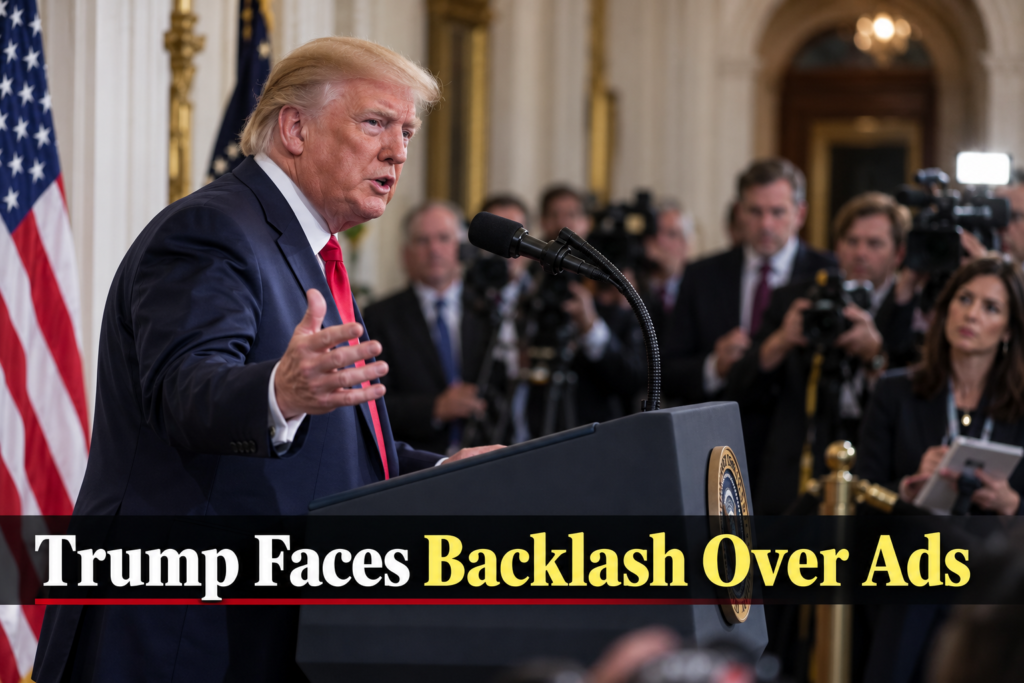
The debate over taxpayer-funded Trump ads took a new turn on Monday, when President Donald Trump said he would stop using federal money for a series of promotional television spots. According to CNBC, he said he and his political action committee would pay instead, after weeks of criticism that came from both parties.
Trump says MAGA Inc. will fund the “Patriotic Ads” from now on, ending the era of taxpayer-funded Trump ads. The White House says that applies to future spots only. No reimbursement plan for ads already aired has been explained, and two House Democrats have asked federal watchdogs to review the spending.
What Trump Announced About the Ads
In a social media post, Trump called the commercials a positive promotion of the country and blamed the “Radical Left” for the outcry. The Hill reported that he wrote he had decided to pay for the “Patriotic Ads, among others” himself, using money raised for MAGA Inc., the pro-Trump super PAC.
The wording left several points open. The White House later clarified that MAGA Inc. would cover what it calls public service ads going forward, and not the ones that have already aired, CNBC reported. The Associated Press noted that Trump gave no details on repaying taxpayers or on how the committee would handle future payments.
How the Taxpayer-Funded Trump Ads Began
The first spot began airing on national networks and cable channels in late September. It was a 30-second commercial that mixed clips of Trump with on-screen text about tax cuts and manufacturing, set to the song “Love Me” by the artist JMSN, CNN reported. Fine print at the end said the government had paid for it.
CBS News reported that several versions exist, some 30 seconds long and others 60 seconds. The White House rejected the idea that the ads were political. It described them as public service announcements and said they were educational and patriotic.
The artist JMSN said on social media that he did not authorize the use of his song. That dispute is separate from the question of who paid for the airtime.
Criticism From Both Parties
Democrats were the loudest critics of the taxpayer-funded Trump ads. Sen. Maggie Hassan wrote to White House chief of staff Susie Wiles and asked how much the ad cost and which agency paid for it. Sen. Jacky Rosen called the spending a waste of taxpayer money, CBS News reported.
Some Republicans also raised questions. According to the Guardian’s live coverage, Senate Majority Leader John Thune and Sens. Mike Rounds, John Kennedy and Thom Tillis questioned the use of public money. FCC Chair Brendan Carr, a Trump appointee, said the ads were appropriate.
Vice President JD Vance defended the campaign as well. He pointed to earlier federal advertising, including ads for the Affordable Care Act under the Obama administration, as proof that governments have long used public funds to promote their programs, The Hill reported.
Oversight Requests and Legal Questions
Reps. Jamie Raskin of Maryland and George Whitesides of California asked the Government Accountability Office to identify the money used and to decide whether the ads broke the law. They also asked the Office of Special Counsel to determine who should be held accountable, according to the Guardian.
The advocacy group Public Citizen separately filed a complaint with both offices. Salon reported that the complaint argues the spending appears to violate rules against using public money for propaganda, as well as the Hatch Act. These are allegations from critics. No finding has been reported yet.
Legal scholars told CBS News that the line between a public service announcement and a political ad is a fine one. They noted that the timing of these spots was not tied to a specific government program.
Costs Remain Unclear
Reported figures on the taxpayer-funded Trump ads differ. The Associated Press said the ads cost at least $1.5 million in federal funds. CNBC said they were reportedly paid from up to $20 million set aside by the government. Both can be true, because one describes spending to date and the other describes a larger reserved amount, but the full total has not been confirmed.
Because of that gap, readers following the taxpayer-funded Trump ads story should treat any single cost estimate with care until the administration or the watchdog agencies release official numbers.
What Happens Next
Several questions are still unanswered. The White House has not said how it would show that political funds are paying for future spots, and it has not addressed repayment for those that have aired. Whether the watchdog agencies will open reviews of the taxpayer-funded Trump ads is also unknown. The announcement comes about four weeks before the November 3 midterm elections, so the issue is likely to stay in the political conversation.
Frequently Asked Questions
What did Trump announce about the ads?
He said he will stop using taxpayer money for the promotional ads and will pay for them with funds raised for MAGA Inc.
Will taxpayers be repaid for ads that already aired?
No plan has been explained. The White House said MAGA Inc. will pay for future ads and not for those already broadcast.
How much did the ads cost?
The Associated Press reported at least $1.5 million in federal funds. CNBC reported that up to $20 million was set aside. The final total is not confirmed.
Who has asked for an investigation?
Reps. Jamie Raskin and George Whitesides wrote to the GAO and the Office of Special Counsel. Public Citizen also filed a complaint with both offices.
How has the administration defended the ads?
The White House calls them educational public service announcements. Vance and FCC Chair Brendan Carr also defended them as normal government messaging.