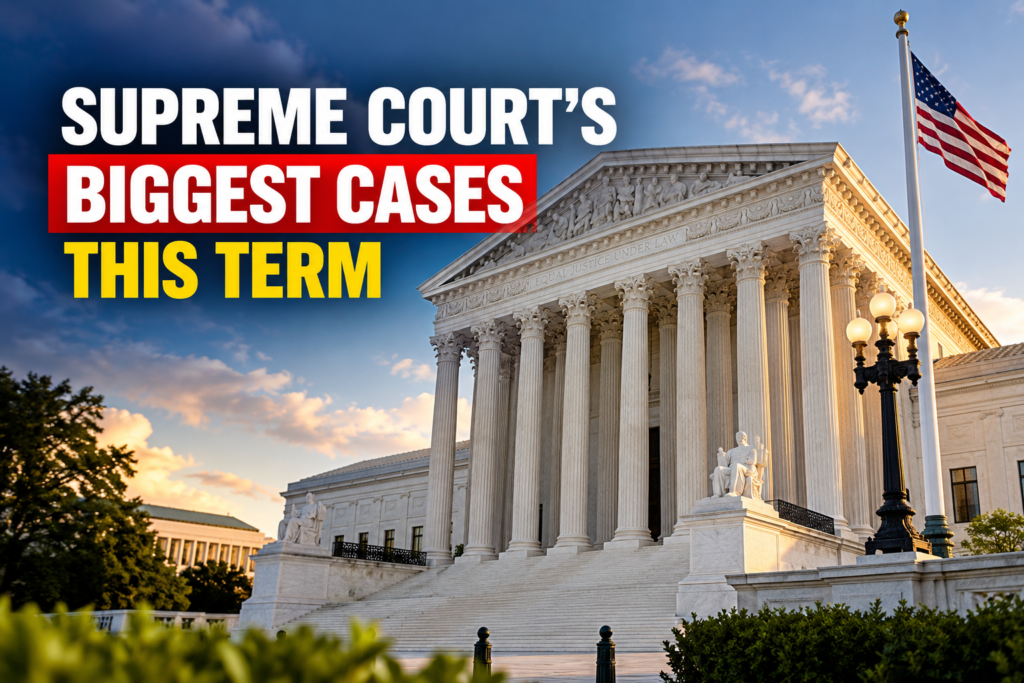
The Supreme Court new term opens on Monday, October 5, 2026, with a calendar that already includes AR-15 bans, proof-of-citizenship rules for voters, and the government’s power to detain immigrants. Many of the biggest arguments are set for the weeks ahead, and the justices are still adding cases as the year goes on.
Supreme Court New Term Opens With a Crowded Docket
This is the court’s second full term since President Donald Trump returned to the White House, according to a preview published by Yahoo News. Roll Call reports that the court, which has six conservative appointees, has lined up disputes over climate change, voting rights, gun rights and federal power over immigrants.
Justices have typically heard between 45 and 80 cases in a term, and they keep agreeing to take new ones along the way. The first day of arguments includes Suncor Energy v. Commissioners of Boulder County, which legal previews place among the term’s climate-related litigation.
| Topic | Detail |
|---|---|
| Term opens | Monday, October 5, 2026 |
| AR-15 ban cases | Viramontes v. Cook County, joined with Grant v. Higgins; argument December 2 |
| Voter citizenship | Republican National Committee v. Mi Familia Vota; argument December 8 |
| Immigration detention | Case from Ricardo Barbosa da Cunha; accepted October 1, argument date not confirmed in sources reviewed |
| Third-country removals | Department of Homeland Security v. D.V.D.; set for December |
| Religious liberty | St. Mary Catholic Parish v. Roy; argument November 3 |
| Typical term size | About 45 to 80 argued cases |
The Supreme Court new term brings a first-of-its-kind test of bans on a specific type of firearm, a fight over Arizona’s voter-registration rules, and two immigration cases tied to the Trump administration. Arguments in the main cases run from November into December. Rulings come later, and the emergency docket could still add surprises.
AR-15 Ban Cases Put the Second Amendment Back in Focus
The court agreed on June 30, 2026, to hear Viramontes v. Cook County. It joined that case with a Connecticut challenge, Grant v. Higgins, the court’s docket summary shows. The question is whether the Second and Fourteenth Amendments protect the right to own AR-15-style and similar semiautomatic rifles.
The two sides share one hour of argument on December 2, according to the court’s December calendar. Cook County’s ordinance covers one Illinois county, while Connecticut’s rule applies statewide. Jurist reported that a win for the challengers would affect similar limits in states such as California, Maryland, Massachusetts, New Jersey, New York and Washington.
Duke University law professor Joseph Blocher told Roll Call this would be the first time the justices address a ban on one particular kind of weapon. He said the outcome could influence how governments treat machine guns, high-capacity magazines and bump stocks. Roll Call added that many experts expect the justices to be skeptical of the bans, given their recent rulings expanding gun rights.
Arizona Proof-of-Citizenship Case Could Reshape Voter Registration
In Republican National Committee v. Mi Familia Vota, the court is reviewing two parts of Arizona election law. One requires people to show documentary proof of citizenship when they register. The other, passed in 2022, calls for periodic checks of voter rolls and cancellation of registrations tied to noncitizens. The justices accepted the case on June 29, 2026.
The Ninth Circuit ruled that the National Voter Registration Act blocks those provisions. It also held that a 2018 consent decree kept the state from requiring proof of citizenship, the court’s question summary explains. Roll Call says the justices will decide whether a state may effectively require proof of citizenship from people registering, and whether federal law bars canceling suspected noncitizens’ registrations close to an election.
Argument is set for December 8, after the midterm elections. George Washington University law professor Alan Morrison said the outcome will likely turn on how the justices read the law’s wording on equivalent forms and necessary documents. The court previously let Arizona enforce part of the law while litigation continued, the National Conference of State Legislatures noted, but kept other provisions on hold.
Yahoo News also reported that voters in six states will consider ballot measures about noncitizen voting in November.
Immigration Detention and Third-Country Removals Reach the Court
On Thursday, October 1, the justices agreed to review the administration’s mandatory detention policy for many immigrants facing deportation. Roll Call explained that the policy rests on a 1996 law. Until last year, administrations applied it mainly to people who recently crossed the border. Since last July, the government has applied it to almost every immigrant in the country without legal status.
The case began with Ricardo Barbosa da Cunha, a Brazilian immigrant who entered the country in 2005 and applied for asylum in 2016. He was detained without bond in 2025. A federal judge ordered a bond hearing, and the Second Circuit later ruled against the administration. Eight other appeals courts reached similar conclusions, while the Fifth and Eighth Circuits sided with the government, Roll Call reported. The policy has affected tens of thousands of people.
The court has also agreed to hear Department of Homeland Security v. D.V.D., about sending immigrants to countries other than their own. That dispute reached the justices through the emergency docket and is now set for argument in December.
Religion Case and the Emergency Docket Add to the Workload
On November 3, the court hears St. Mary Catholic Parish v. Roy, according to the November argument calendar. Two Catholic parishes say Colorado shut them out of its universal preschool program because of their religious beliefs. The program offers families up to about $6,000, OSV News reported. Colorado has argued that the parishes want an exemption from a nondiscrimination rule.
Outside the regular schedule, the emergency docket keeps growing. Georgetown professor Stephen Vladeck told NPR that full-court rulings on emergency requests now outnumber merits rulings by about two to one. Those decisions often arrive within days or weeks and without full oral arguments.
Election disputes may also land quickly. University of Chicago law professor William Baude said the justices may have little control over whether they get pulled in, and earlier disputes this year involved Missouri’s congressional map and mail voting changes.
What to Watch as Arguments Begin
The calendar gives readers a few clear dates: November 3 for the Colorado preschool case, December 2 for the AR-15 cases and December 8 for the Arizona voting dispute. The two immigration cases add more weight to the winter schedule.
Some experts say the term’s biggest cases may not be on the docket yet. Because arguments are only starting, none of these outcomes can be predicted with confidence.
Frequently Asked Questions
1. When does the Supreme Court new term begin?
It begins on Monday, October 5, 2026, according to the court’s argument calendar.
2. Which gun cases will the court hear?
Viramontes v. Cook County and Grant v. Higgins, combined for one hour of argument on December 2. They ask whether the Constitution protects AR-15-style rifles from bans.
3. What is the Arizona voting case about?
It tests whether federal law or a consent decree stops Arizona from requiring proof of citizenship at registration, and whether federal law limits canceling suspected noncitizens’ registrations near an election. Argument is set for December 8.
4. Which immigration cases has the court accepted?
One challenges the mandatory detention policy through the case of Ricardo Barbosa da Cunha. The other, Department of Homeland Security v. D.V.D., concerns third-country removals and is set for December.
5. When will rulings arrive?
The court has not announced decision dates. Reporting on the Colorado preschool case says a ruling is expected before the term ends next summer.