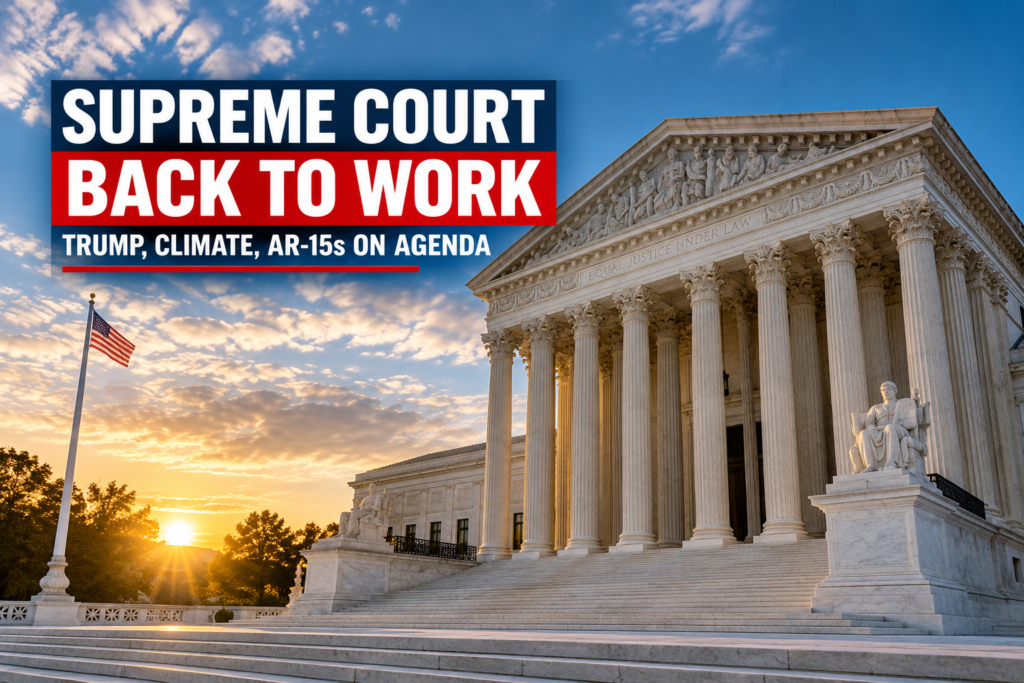
The Supreme Court new term opens on Monday, Oct. 5, 2026, with a case that could decide whether cities and counties can sue oil companies over the costs of climate change. The justices are returning from their summer break to a docket that also touches gun rights, religious freedom, immigration and elections, and many more cases are still to be added.
The Supreme Court new term starts with a Boulder, Colorado, climate lawsuit against two energy companies. A Catholic preschool dispute follows on Nov. 3, and a challenge to AR-15 bans is set for December. Two immigration policies are also on the schedule, and the docket is only about half full.
How the Supreme Court New Term Opens With a Climate Case
The first argument is Suncor Energy v. County Commissioners of Boulder County, No. 25-170. The city and county of Boulder sued Suncor and Exxon Mobil, and the Colorado Supreme Court let the case move forward in May 2025, according to Boulder County.
The justices will weigh two questions. One is whether federal law blocks state-law claims over harm allegedly caused by greenhouse gas emissions from around the world. The other is whether the Supreme Court has the authority to hear the case at all, SCOTUSblog reported.
What each side says
Boulder argues the companies knew their products would alter the climate and misled the public about the risks. The companies say federal law shields them from such claims. Kevin Russell will argue for Boulder, and Kannon Shanmugam represents Suncor.
The Trump administration is siding with the energy industry. It has argued that the Clean Air Act rules out state-law suits of this kind. E&E News reported that the government asked for 10 minutes of argument time.
Why the stakes reach beyond Boulder
Dozens of similar lawsuits have been filed by local and state governments, and billions of dollars could be at stake. USA Today reported that the ruling could shape how far one state can reach activity that begins elsewhere. Bridget Fahey of the University of Chicago Law School described the case as a possible stand-in for future fights over state regulation of artificial intelligence. Michael Williams, West Virginia’s solicitor general, represents Republican attorneys general who say one state should not regulate conduct in another.
Recusal has also become part of the story. Watchdog groups have urged Justice Samuel Alito to step aside because of his oil-industry stock holdings, and conservative groups have questioned whether Justice Elena Kagan should have recused herself, according to reports by Bloomberg Law and E&E News.
Key Facts About the Court’s Opening Weeks
Religion Cases: A Catholic Preschool and the Ten Commandments
On Nov. 3, the court will hear St. Mary Catholic Parish v. Roy. Two Catholic parishes in the Archdiocese of Denver say Colorado excluded their preschools from its universal preschool program because of their religious beliefs. National Catholic Reporter noted that the program offers up to about $6,000 per child, which parents can use at public or private schools.
Colorado says its nondiscrimination rules are neutral and apply to every participating provider. Lower courts sided with the state, relying on the 1990 decision in Employment Division v. Smith. Roman Martinez, an attorney who frequently argues before the court, told a Georgetown Law audience that Colorado has not fared well in similar cases, and he expects the church to win.
A second religion case may follow. Families backed by the ACLU have asked the justices to review a Texas law requiring public schools to display the Ten Commandments. The 5th U.S. Circuit Court of Appeals upheld the law, even though the court struck down a similar Kentucky law in 1980. First Amendment scholar Genevieve Lakier said it is unclear whether the court will take the case, given its recent expansion of religious exercise rights.
The Second Amendment and AR-15 Bans
In December, the justices will hear consolidated challenges to bans on AR-15-style rifles in Cook County, Illinois, and in Connecticut. The court agreed to take them up on June 30, the Associated Press reported. Connecticut’s law dates to 1993 and was tightened after the 2012 Sandy Hook Elementary School shooting.
CBS News reported that the court had previously declined similar appeals from Illinois and Maryland. Gun owners argue the AR-15 is the most popular rifle in the country. A federal appeals panel upheld Connecticut’s law as consistent with the nation’s history of firearm regulation, using a test the Supreme Court set in 2022.
Don Verrilli, a former solicitor general under President Barack Obama, called the matter potentially the most important Second Amendment case since 2008. He noted that earlier rulings covered who has gun rights and where, while this one asks which firearms are protected. Verrilli predicts the court will say AR-15s cannot be banned, but he believes the case also raises doubts about the history-based test itself.
Trump Administration Policies and Election Disputes
Last term, the court rejected the president’s sweeping tariffs and his attempt to redefine birthright citizenship. This term, the justices will review two immigration practices. One is whether the administration can detain millions of immigrants without a chance to seek bond. The other is whether it can deport people to countries other than their own without letting them argue they could face persecution or torture there.
Further challenges are likely. Erwin Chemerinsky of the University of California, Berkeley, School of Law noted that the court has chosen only about half of the cases it will hear. He said new tariffs and clashes between congressional Democrats and the administration could be added, particularly if Democrats win control of the House or Senate in November.
Elections may also land on the court’s desk. The justices will hear a Republican push to enforce strict Arizona voting laws in December. Cecilia Wang of the ACLU said to expect emergency applications tied to the November midterms.
What to Watch Next
The Supreme Court new term will feature Colorado cases early, with the climate lawsuit on opening day and the preschool dispute on Election Day, as Law Week Colorado noted. Last term, the court heard just under 60 cases, and the term runs through the end of June.
Frequently Asked Questions
1When does the Supreme Court new term begin?
It begins Monday, Oct. 5, 2026, with oral argument in Suncor Energy v. Boulder County, the first of seven cases in the October sitting.
2What is the Boulder climate case about?
Boulder sued Suncor and Exxon Mobil under state law. The justices will decide whether federal law bars such claims and whether the court can hear the case.
3What is the Catholic preschool case?
St. Mary Catholic Parish v. Roy is set for Nov. 3. It asks whether Colorado’s exclusion of Catholic preschools from its universal preschool program violates the First Amendment.
4What will the justices decide on AR-15 bans?
They will consider whether state and local governments can ban semiautomatic rifles like the AR-15 under the Second Amendment, in cases from Cook County, Illinois, and Connecticut.
5Will more cases join the Supreme Court new term?
Yes. The court has selected only about half of its cases, and more challenges to Trump administration policies are likely.