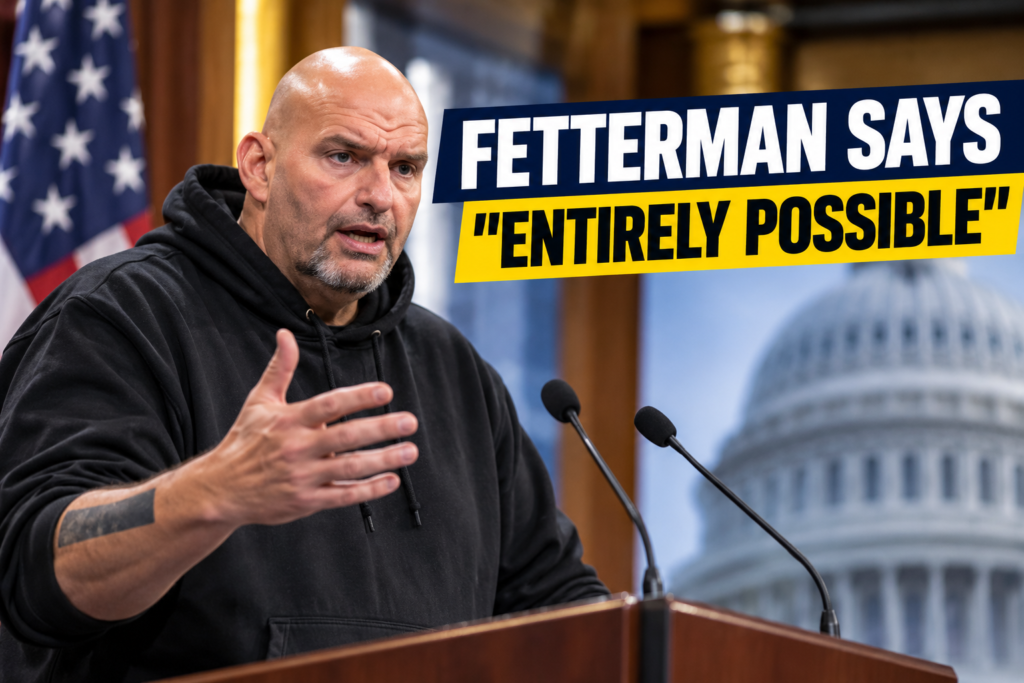
Pennsylvania Democratic Sen. John Fetterman said Saturday that a Senate majority for Democrats is “entirely possible” heading into the 2026 midterm elections, even as he continued to sidestep questions about his own political future and relationship with his party.
Speaking with CBS News’ Major Garrett at the Texas Tribune Festival in Austin, Fetterman repeatedly declined to say whether he would seek re-election in 2028 or stay aligned with Democrats long-term, telling the audience, “Let’s revisit after the midterm.”
Why Fetterman Thinks a Senate Majority for Democrats Is Possible
Republicans currently hold 53 seats in the Senate, and the map heading into the midterms initially looked favorable to the GOP. But Fetterman argued the political environment has shifted in Democrats’ favor as affordability concerns have persisted under the Trump administration and public frustration has grown over the unpopular war with Iran.
Fetterman, who won a closely watched 2022 Senate race that Democrats view as pivotal to their current numbers, pointed to recent polling as evidence of momentum. He called a Marist poll showing Democratic Senate candidate Josh Turek leading by eight points in Iowa “shocking,” citing it as one of several races where Democrats are outperforming expectations.
That kind of movement, Fetterman suggested, is exactly why a Senate majority for Democrats is no longer a long-shot scenario the way it appeared to be earlier in the cycle. He argued that voters frustrated by rising costs and an unpopular foreign conflict are willing to reconsider races that once looked safely Republican, giving Democratic candidates room to compete even in traditionally red-leaning states.
Fetterman Stays Coy on His Political Future
Fetterman’s remarks come weeks after he made a surprise video appearance at the Republican midterm convention, introducing GOP Sen. Dave McCormick and pledging to work with President Trump on steel policy. That move rattled many Democrats and fueled speculation that Fetterman could eventually leave the party.
Asked directly on Saturday whether he plans to leave the Democratic Party, Fetterman said he doesn’t “have a reason to” and insisted, “I am not a Republican.” He added flatly, “I have no path as a Republican,” noting that no current GOP lawmakers hold consistently liberal voting records on issues such as abortion rights or LGBTQ+ protections.
Still, he left room for ambiguity about what comes next. “Let’s see what happens if I happen to be 51 — I don’t know,” Fetterman said, an apparent reference to the pivotal 51st vote needed for a Democratic majority. He framed his own re-election in Pennsylvania as proof that a broader coalition, including some voters who lean conservative on cultural issues, can still be persuaded to back Democratic candidates in competitive states.
Fetterman also brushed aside the idea that his convention appearance signaled a deeper rift, describing himself instead as a lawmaker willing to engage with anyone “playing it straight,” regardless of party. That framing has become a consistent theme of his time in the Senate, even as it continues to draw scrutiny from Democratic colleagues and progressive activists.
Fetterman on the Democratic Party’s Direction
Fetterman used the appearance to air broader frustrations with his party. He argued that “more and more members” of the Democratic caucus have grown “more and more anti-Israel,” reiterating his own strong pro-Israel stance as a point of departure from progressive colleagues.
He also cited the recent federal government shutdowns as a flashpoint, saying he broke from most Democrats because he believes in “putting the country over the party.” Fetterman argued that shutting down the government has traditionally been viewed by Democrats as a tactic to avoid, and that his decision to oppose it put him at odds with much of his caucus.
He referenced attendance at a nearby event featuring streamer Hasan Piker as a sign of the energy driving parts of the Democratic base, alongside a string of recent wins by insurgent Democratic candidates. Fetterman said he sees that energy as evidence the party is finding its footing again, even if he personally disagrees with some of the direction it is taking.
Schumer’s Leadership and the Path to a Senate Majority for Democrats
Asked whether Senate Minority Leader Chuck Schumer should keep his post if Democrats win the majority, Fetterman was supportive, saying, “There’s no one making a move.” He praised Schumer’s recruiting efforts this cycle, adding, “If people are angry at Chuck Schumer, it’s undeniable, he has recruited an incredibly strong class.”
Pennsylvania remains one of only a handful of states with a split Senate delegation — one Democrat and one Republican — alongside Wisconsin, while Maine has one Republican and one independent who caucuses with Democrats. Pennsylvania has swung between Democratic and Republican presidential candidates in recent election cycles, making it one of the most closely watched battlegrounds heading into November.
Fetterman’s comments add to a growing body of evidence, including internal party polling and candidate fundraising totals, that Democrats believe they have a genuine opening this cycle. Whether that translates into an actual Senate majority for Democrats will depend on a handful of competitive races in states like Iowa, Texas, and North Carolina, according to strategists tracking the midterm map.
📌 Quick Summary
Sen. John Fetterman says a Senate majority for Democrats is “entirely possible” in 2026, citing affordability concerns and Iran War fallout hurting Republicans. He denies plans to leave the Democratic Party but is delaying decisions on his 2028 re-election bid and party loyalty until after the midterms.
Key Facts
| Detail | Information |
| Who | Sen. John Fetterman (D-Pennsylvania) |
| Where | Texas Tribune Festival, Austin, Texas |
| Interviewer | CBS News’ Major Garrett |
| Current Senate makeup | 53 Republicans, 47 Democrats/independents |
| Key claim | A Senate majority for Democrats is “entirely possible” |
| Political future | Decision on party affiliation and 2028 re-election delayed until after midterms |
Frequently Asked Questions
Q: Did John Fetterman say he’s leaving the Democratic Party?
No. Fetterman said he doesn’t “have a reason to” leave and stated, “I am not a Republican,” though he declined to rule out future changes until after the midterms.
Q: Does Fetterman think Democrats can win back the Senate in 2026?
Yes. He called a Senate majority for Democrats “entirely possible,” pointing to affordability issues and backlash over the Iran war as factors helping Democrats.
Q: Why did Fetterman appear at the Republican midterm convention?
He appeared by video to introduce Sen. Dave McCormick and pledged to work with President Trump on steel policy, a move that surprised many fellow Democrats.
Q: Does Fetterman support Chuck Schumer remaining Senate leader?
Yes. Fetterman said he would back Schumer, noting “there’s no one making a move” against him, and praised Schumer’s Senate candidate recruiting.
Q: Has Fetterman decided whether he’ll run for re-election in 2028?
Not yet. Fetterman said he is actively fundraising but will make a final decision after the 2026 midterm elections.