
WEATHER · U.S. NORTHEAST
Northeast Nor’easter Power Outages Top 130,000 as Coastal Towns Face Another High Tide
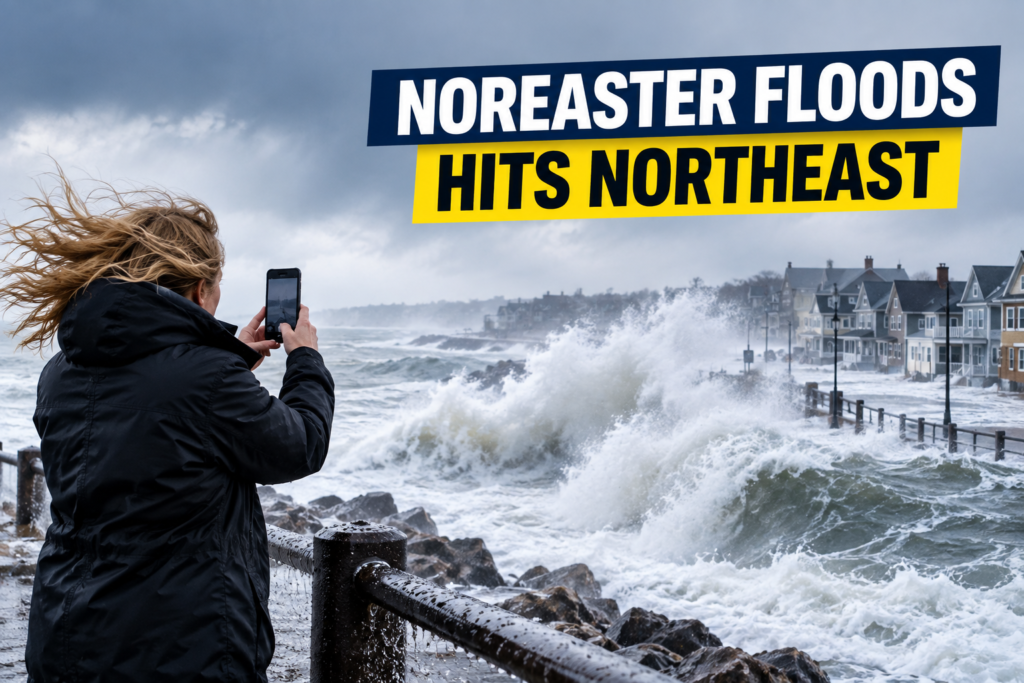
A slow-moving nor’easter kept its grip on the Northeast through the weekend, flooding shore towns and cutting electricity to well over 100,000 homes and businesses. The Northeast nor’easter power outages climbed past 130,000 on Sunday morning before crews began chipping away at the total, even as forecasters warned that another high tide could send seawater back into low-lying streets before the storm finally pulls away.
The storm parked itself just offshore of Long Island and northern New Jersey, circling the region rather than moving through it, which is why the rain, wind and tidal surge dragged on for days instead of clearing in an afternoon.
Key Facts
| Detail | Figure / Status |
| Customers without power (peak, Sun. a.m.) | About 136,000 across five states |
| States hit hardest | New Jersey, New York, Connecticut, Massachusetts |
| Fatalities | 1 (tree fell on a worker in Brooklyn, N.Y.) |
| Flights canceled | More than 400 nationwide over the weekend |
| Lead forecaster | Bob Oravec, National Weather Service |
At a glance
The storm has lingered off the coast for days rather than passing through quickly, driving outage numbers up and down as crews restore lines only to see new ones knocked out by wind and falling trees. New Jersey’s shore towns have taken the worst of the flooding, Long Island has seen widespread tree damage, and forecasters say the tidal threat won’t fully ease until the system finally spins away.
Storm Track and Forecast
Meteorologists tracked the storm sitting just south of Long Island and east of northern New Jersey through Sunday morning, looping in place instead of moving off the coast. Forecasters expected the system to circle the region for roughly another day before finally weakening and pulling away.
Bob Oravec, a lead forecaster with the National Weather Service office in College Park, Maryland, said the heaviest remaining rain was aimed at northern New Jersey, New York City, Long Island and southern New England. He noted that wind and repeated high tides, more than the rainfall itself, posed the biggest ongoing risk to coastal communities.
Coastal Flooding Hits the Jersey Shore and Long Island
New Jersey Gov. Mikie Sherrill said shore communities took a beating from the storm, pointing to significant erosion along the dunes in Brigantine and Atlantic City. State officials said they were still assessing the extent of the damage as of Sunday.
On Long Island, falling trees tore down power lines, damaged homes and vehicles, and blocked roads throughout the weekend, making it one of the hardest-hit areas for outages. In parts of New Jersey and New York, flooded streets turned into makeshift waterways: some residents paddled kayaks down their own blocks, while others headed to the coast to ride unusually large waves. Emergency crews in Sea Bright, New Jersey, pulled a woman and her dog from a car that had become trapped in rising floodwater.
The National Weather Service continued to track high-tide cycles Sunday morning and evening as the periods of greatest flood risk for the coastline.
One Death Reported in Brooklyn
The storm has been tied to one death so far. A 56-year-old New York City Housing Authority employee died Saturday after a tree fell on him near the Cypress Hills Houses in East New York, Brooklyn, according to police. He was taken to a hospital and later died of his injuries.
The Federal Emergency Management Agency said its regional response coordination centers were operating at an elevated readiness level, with teams staged in New England in case outages or flooding worsened further.
Travel and Weekend Events Disrupted
The storm forced more than 400 flight cancellations along the East Coast over the weekend, with delays rippling through major airports from the mid-Atlantic into New England.
The disruption reached into sports and entertainment as well. The Boston Red Sox and Chicago Cubs rearranged their final regular-season series around the weather, playing a doubleheader in Boston ahead of the storm and later moving their finale to Florida. Ed Sheeran canceled a pair of concerts at Gillette Stadium in Foxborough, Massachusetts, that had been scheduled for Friday and Saturday.
How This Storm Compares
The scale of this weekend’s flooding has drawn comparisons to Superstorm Sandy, the 2012 storm that caused more than $60 billion in damage across the eastern United States. Meteorologists stress that this nor’easter is far less severe than Sandy, but some forecasters see it as an early sign of an active fall storm season, tied in part to an El Niño pattern that has been reshaping this year’s weather across the country.
Frequently Asked Questions
How many people lost power in the Northeast nor’easter?
Outages peaked at roughly 136,000 customers across five states on Sunday morning, then declined to about 110,000 by early afternoon as crews made repairs, according to tracking site PowerOutage.us.
Which states were hit hardest by outages?
New Jersey, New York, Connecticut and Massachusetts reported the most widespread outages, with New Jersey’s Ocean and Monmouth counties and New York’s Suffolk County among the worst affected.
Were there any deaths from the storm?
Yes. A 56-year-old New York City Housing Authority worker died Saturday after a tree fell on him in East New York, Brooklyn.
When is the storm expected to move away?
As of Sunday morning, forecasters expected the storm to keep circling near Long Island and northern New Jersey for roughly another 24 hours before gradually weakening and pulling away.
Did the storm affect travel and events?
Yes. More than 400 flights were canceled, an MLB series between the Red Sox and Cubs was rescheduled, and Ed Sheeran canceled two concerts at Gillette Stadium.
Reporting drawn from The Associated Press and additional coverage from CNN, NBC News and Reuters. Figures reflect conditions reported on Sunday, September 27, 2026, and may have changed as recovery efforts continued.