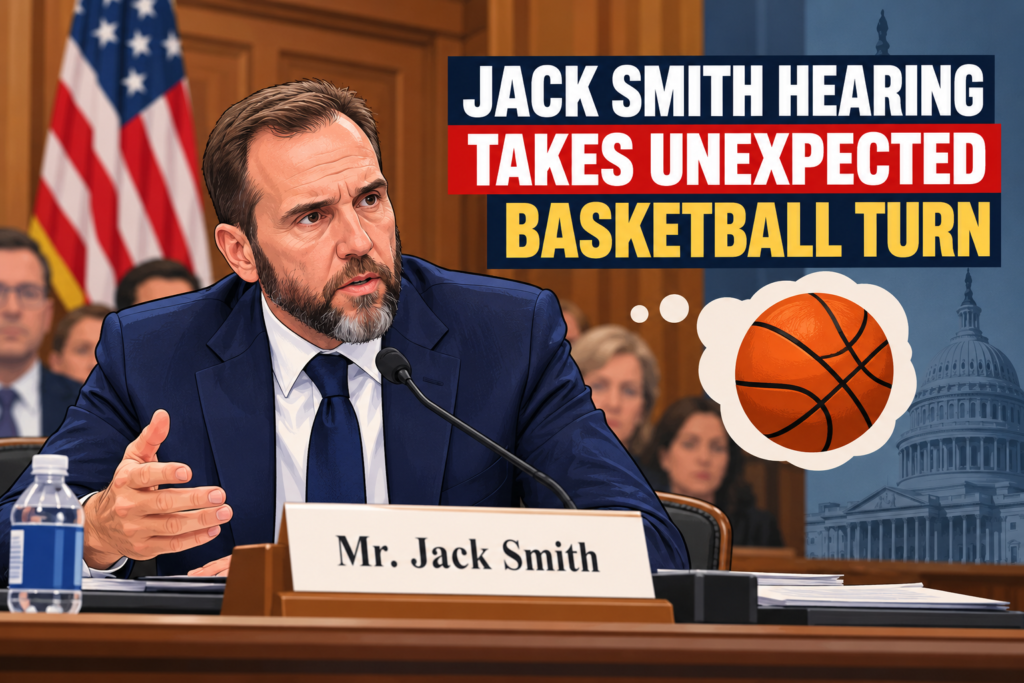
Former special counsel Jack Smith told the Senate Judiciary Committee on Tuesday that he stands by his decision to charge President Donald Trump. The Jack Smith Senate testimony, held on Sept. 29, 2026, lasted more than four hours and grew heated at several points as Republicans accused him of abusing his authority and Democrats defended his work.
What Happened at the Jack Smith Senate Testimony
Smith led two federal prosecutions of Trump. One involved the handling of classified documents after Trump left the White House. The other centered on Trump’s alleged efforts to overturn his 2020 election loss. Both cases ended after Trump won the 2024 election, and Trump has long denied wrongdoing.
The hearing was titled “Oversight of Jack Smith’s Abuse of Authority and the Targeting of Republicans.” Chairman Chuck Grassley, an Iowa Republican, presided. Sen. Dick Durbin of Illinois was the ranking Democrat. The session was scheduled to begin at 9 a.m. Eastern.
Smith had answered lawmakers’ questions before. He gave a closed-door deposition to the House Judiciary Committee in December and appeared in a public House hearing in January.
Key Facts
| Detail | What we know |
|---|---|
| Date | Tuesday, Sept. 29, 2026 |
| Venue | Senate Judiciary Committee, Capitol Hill |
| Witness | Jack Smith, former special counsel |
| Chair / ranking member | Chuck Grassley (R-Iowa) / Dick Durbin (D-Ill.) |
| Length | More than four hours |
| Smith’s main message | He stands by charging Trump and would do so again |
| Republican focus | Subpoenas and phone records tied to GOP lawmakers |
| Status of Trump cases | Neither reached a jury; both ended after the 2024 election |
Smith defended both Trump investigations, said he would bring the same charges regardless of a president’s party, and called the targeting of his former team an outrage. Republicans attacked his subpoenas and conduct. Democrats called the criticism a distraction from the January 6 evidence.
Smith Defends His Decision to Charge Trump
In his opening statement, Smith said he made his decisions without regard to Trump’s politics or his 2024 candidacy. He said that if he faced the same facts about a former president today, he would prosecute no matter whether that president was a Republican or a Democrat.
According to his prepared remarks, obtained by CBS News, Smith also said his investigation developed proof beyond a reasonable doubt of criminal activity by Trump. He said he would not be silenced by threats of prosecution and warned that the rule of law faces serious challenges.
Smith’s final report echoed that view. In its first volume, on the 2020 election case, he wrote that the evidence was sufficient to obtain and sustain a conviction at trial, but for Trump’s election and return to the presidency.
Republicans Focus on Subpoenas and Phone Records
Republicans repeatedly questioned Smith about efforts to obtain records from lawmakers and outside groups. Grassley asked whether Smith’s office unfairly sought financial information from Republican organizations. Smith acknowledged that investigators acquired financial information. He said he could not recite every subpoena from memory, but that each one served a criminal investigation.
Grassley called the operation a partisan weapon. Sen. Ted Cruz, a Texas Republican, said Smith’s conduct was the worst abuse of power in Justice Department history.
Why the toll records matter
Republicans have objected to toll records that Smith’s team obtained for some GOP lawmakers. Those records show details such as phone numbers and the time and length of calls, not the content of calls or messages. Smith has said gathering them is common practice in complex investigations and that the records covered the period when Trump and others sought to disrupt certification of the 2020 result.
Documents the Justice Department gave the Senate committee in July also showed Smith’s team obtained text messages from the National Archives that included messages from 44 members of Congress, both Republicans and Democrats. Republicans have accused Smith of lying about this in his December deposition. His attorneys reject that claim.
A mix-up over a basketball game
One exchange drew attention. Sen. Eric Schmitt, a Missouri Republican, cited text messages he said showed Smith attended an Atlanta Hawks game on Feb. 3, 2024, and suggested Smith might have misled the committee. Smith said he did not recall that. After Sen. Amy Klobuchar pressed for an explanation, Smith said the game he attended that day involved the Iowa Hawkeyes, not the Atlanta Hawks.
Democrats Push Back and Smith Backs His Team
Durbin said the criticism of Smith was petty and political and served as a smokescreen. He noted that Smith offered to testify publicly nearly a year ago. Sen. Cory Booker accused Republicans of gaslighting the public about the 2020 election.
Smith also spoke up for former colleagues. Many members of his team, he said, have been fired or otherwise targeted, and he called that an outrage. Nearly every prosecutor and agent tied to his investigations has since resigned or been fired, according to ABC News.
Legal Pressure Still Surrounds Smith
House Judiciary Chairman Jim Jordan referred Smith to the Justice Department in July over statements about the phone records. Attorney General Todd Blanche said the same month that the department was investigating the referral. Smith’s attorneys called the claims spurious and said they took his testimony out of context. Trump has repeatedly said Smith should be prosecuted.
The classified documents case remains a limit on what Smith can say. A judge blocked release of the second volume of his report, and a standing order from Judge Aileen Cannon bars officials from revealing information that could be part of it. An appeals court is weighing a lawsuit by advocacy groups seeking to lift that order, as reported by ABC News.
Frequently Asked Questions
1. When did the Jack Smith Senate testimony take place?
It took place on Tuesday, Sept. 29, 2026, before the Senate Judiciary Committee.
2. What did Smith say about charging Trump?
He said he stands by his decisions, made them without regard to politics, and would prosecute a former president on the same facts regardless of party.
3. Why were Republicans critical of Smith?
They questioned his use of subpoenas, including toll records for some GOP lawmakers, and accused him of abusing his authority.
4. Did the Trump cases go to trial?
No. Neither case reached a jury. Both ended after Trump won the 2024 election, and Trump pleaded not guilty in both.
5. Is Smith under investigation?
Attorney General Todd Blanche said in July that the Justice Department was investigating a Republican criminal referral against Smith. Smith’s attorneys dispute its basis.