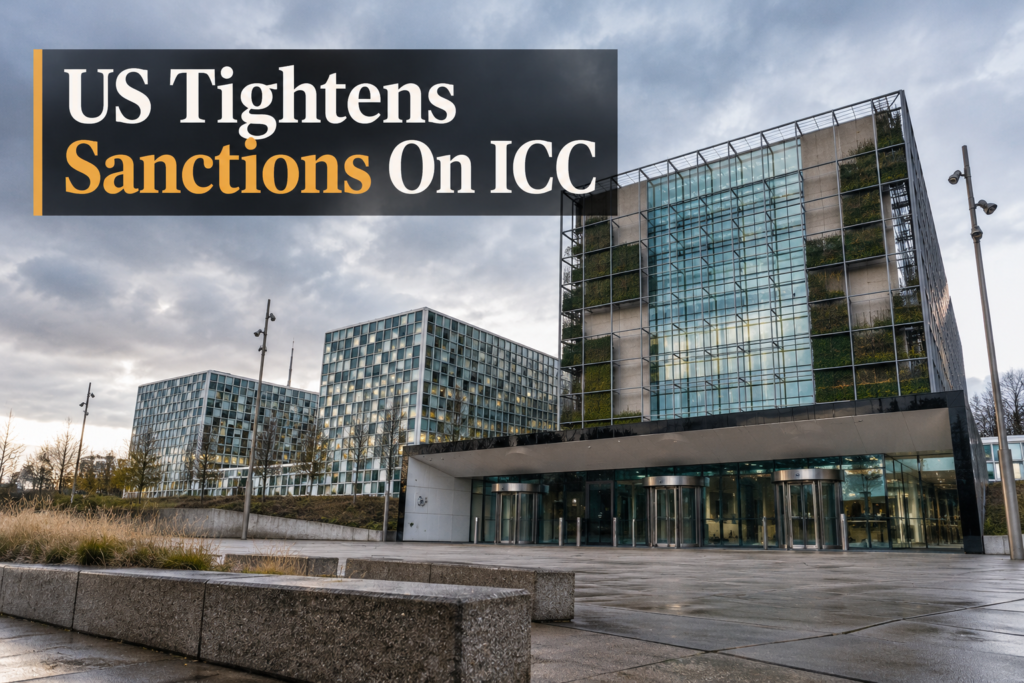
The United States has announced new ICC sanctions that target the International Criminal Court itself, not only its judges and prosecutors. Secretary of State Marco Rubio revealed the step on Friday, October 9, 2026, in a video posted on X, according to Global News.
Washington has moved against the court as an institution. Assets in U.S. jurisdiction are blocked, and U.S. companies and individuals have six months to wind down business with it. The court calls the move an attack on the rule of law, and the UN secretary-general calls it a serious blow to international criminal justice.
What the new ICC sanctions do
The ICC sanctions block any assets the court holds in U.S. jurisdiction, The Guardian reported. American companies and individuals get six months to end their dealings with the tribunal. The rules also exempt certain transactions, and they leave room for the court to address Washington’s concerns.
Earlier penalties focused on people. As Al Jazeera noted, the U.S. had already sanctioned ICC judges and prosecutors, a UN special rapporteur and Palestinian rights groups that supplied evidence to the court. This round of ICC sanctions is different because it covers the institution. Companies that provide services to the court could now face penalties.
The practical effect is still being weighed. William Schabas, a professor of international law, told Al Jazeera it was not immediately clear how strongly the measures would bite. Sanctions of this type can lead banks, insurers and software providers to cut ties, TRT World reported, which is why observers are watching the court’s day-to-day operations closely.
What Rubio said about the court
Rubio called the tribunal a “rogue” court and said the United States and its citizens are not subject to its jurisdiction. He added that America never joined the court and does not need or want it. His sharpest line was: “Either the ICC will end its threats, or we will end the ICC.”
He also turned to U.S. allies. Rubio said Washington expects court member countries, many of which rely on American troops for their defense, to rein in the tribunal. If they do not, he warned, the campaign against the court will continue in stages, Global News reported. At the same time, the ICC sanctions were structured to give the court and its members a chance to resolve U.S. concerns, according to TRT World.
How the court and the UN responded
The ICC pushed back firmly. In a statement, it described the sanctions as an attempt to obstruct justice and an assault on the foundations of the international legal order. It warned that history will judge this moment and urged its member states to make sure the court can keep working.
UN Secretary-General António Guterres said he was deeply alarmed about the impact on the court’s ability to carry out its mandates. UN News reported that he called the step a serious blow to international criminal justice, with the ICC as one of its key pillars. The same report said U.S. measures were already in place against 13 judges and prosecutors.
Why the timing of the ICC sanctions drew attention
The announcement came only hours after South African jurist Navi Pillay won the 2026 Nobel Peace Prize, according to Anadolu reporting carried by Middle East Monitor. Pillay served on the ICC’s Appeals Chamber from 2003 to 2008. Several outlets pointed out how close the two events were. None of the reports reviewed says the sanctions were a direct response to the award.
A longer campaign against the court
The ICC was set up in 2002 to hold people accountable for war crimes, genocide and crimes against humanity. During his first term, President Donald Trump sanctioned the court, and those penalties were later reversed under the Biden administration, The Guardian reported. After he returned to office in 2025, he signed an executive order imposing sanctions over the court’s investigations involving Israelis and Americans.
More steps followed. The administration sanctioned judges and lawyers connected to the court, and in August it targeted ICC president Tomoko Akane. Tension had also grown after the court issued arrest warrants in November 2024 for Israeli Prime Minister Benjamin Netanyahu and former defense minister Yoav Gallant over alleged war crimes in Gaza, according to Middle East Monitor.
What remains unclear
The story is still developing. The sources reviewed do not say which transactions are exempt, how banks and service providers will respond to the ICC sanctions, or whether any member countries will act on Rubio’s request. Readers should watch for official statements from the State Department, the court and its member states.
Key facts at a glance
Frequently asked questions
1. What did the United States announce?
Rubio announced sanctions on the International Criminal Court itself on October 9, 2026, in a video posted on X.
2. What do the ICC sanctions block?
They block any assets the court has in U.S. jurisdiction. American companies and individuals have six months to wind down business with it, and certain transactions are exempt.
3. How did the ICC respond?
The court called the move an attempt to obstruct justice and an assault on the rule of law. It urged member states to ensure it can keep functioning.
4. What did the United Nations say?
Secretary-General António Guterres said he was deeply alarmed and described the sanctions as a serious blow to international criminal justice.
5. Has the U.S. sanctioned the court before?
Yes. Sanctions were imposed during Trump’s first term and reversed under Biden. After 2025, new measures hit judges, lawyers and ICC president Tomoko Akane. UN News counts 13 judges and prosecutors sanctioned before this round.
This report is based on the sources linked above and may be updated as official statements are released.