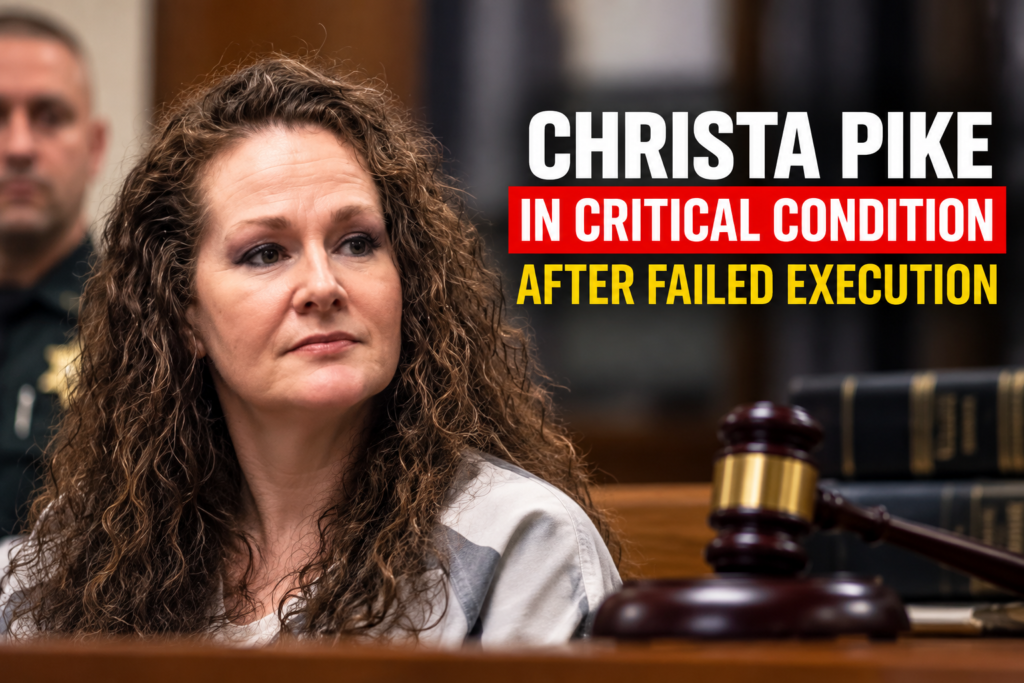
The Christa Pike failed execution has left Tennessee facing serious questions about its lethal injection process. Pike, 50, survived an attempt to put her to death on Wednesday night and was still in critical condition at a hospital on Thursday, her lawyers said, as NBC News reported.
Tennessee tried to execute Christa Pike by lethal injection, but she did not die. Her lawyers say she is receiving life-saving care. Gov. Bill Lee has ordered an independent review and halted the remaining 2026 execution. Many questions, including her long-term outlook, remain unanswered.
What happened in the Christa Pike failed execution
Pike was scheduled to be executed on Wednesday, Sept. 30, at a prison in Nashville. She was sentenced to death for a 1995 murder committed when she was 18. Had the procedure worked, she would have been the first woman Tennessee executed in more than 200 years.
According to the Associated Press, the state gave an initial dose and a backup dose of pentobarbital, but neither ended her life. The AP also reported that Pike was still making snoring sounds when the chamber’s microphone was turned off, more than an hour into the attempt.
Randall Spivey, one of Pike’s lawyers, witnessed the attempt. He told reporters that at least seven needles were used in her left arm alone, and that one looked bent when it was removed. He also said five minutes after the second dose it was clear she was still breathing. Media witnesses described her saying her arm felt as if it might burst.
A court ruling delayed the procedure
The execution did not go ahead at its planned time. ABC News reported that a lower court had paused it, and the Supreme Court later voted 6-3 to let Tennessee proceed before the death warrant expired at midnight. The AP said the injection began about eight hours after the original schedule.
Spivey said he was given an emergency phone number for the Tennessee Supreme Court in case something went wrong, but his call went to voicemail. An ambulance was called to the prison at 8:50 p.m., according to NBC News.
Governor orders an independent review
Gov. Bill Lee called the outcome a tragedy and said it should not have happened. He said he would hire a team to investigate, and the AP reported that he canceled the state’s only other execution planned for this year, set for Dec. 3. Lee said the review should take as long as needed so that all questions are answered.
Pike’s lawyers say the review does not go far enough. In remarks reported by UPI, Spivey said the governor should commute her sentence now. Her attorneys have also appealed.
This was the second troubled execution in Tennessee this year. In May, officials were unable to find a vein for a backup IV during the planned execution of Tony Carruthers, who then received a one-year reprieve, NBC News reported.
What medical experts say could have gone wrong
Medical experts told NBC News that Pike’s injuries could fit a situation in which the drug leaked into tissue around the injection site instead of entering a vein. Dr. Jonathan Groner, an emeritus professor of clinical surgery at Ohio State University, said less of the drug would then reach the bloodstream, which could keep a person breathing.
Stephen Ferrell, another Pike lawyer, said a number of factors may be involved. He pointed to her difficult veins and said the IV line may have infiltrated. These are early explanations from lawyers and outside experts, not findings by the state. The independent review is meant to establish what actually occurred.
Her legal team says it had warned courts months earlier about problems with her veins, according to Axios Nashville. A death penalty expert told the AP that her survival after receiving the drug was unprecedented.
Background on the case
Pike was convicted of the 1995 killing of Colleen Slemmer, a fellow student at a Knoxville program. Pike was 18 at the time. Her attorneys have long argued that jurors never heard the full story of her abusive childhood, a point also raised in a clemency request filed in September. Governor Lee declined clemency before the execution date.
Slemmer’s mother traveled to Nashville to watch the execution. After the failed attempt, she told reporters she had not received justice for her daughter, NBC News reported.
Political reaction and what comes next
Elected officials are pressing for answers. Axios reported that U.S. Sen. Marsha Blackburn, who is seeking the governor’s office, criticized the process and urged the state to bring back the electric chair. The failed attempt also revived debate over Tennessee’s single-drug lethal injection method, the AP said.
For now, Pike’s prognosis is unknown, and the review has no announced timeline. Her lawyers said they have not seen her in the hospital. Further details are expected to depend on the findings of the independent investigation and any court action on her appeal.
Frequently Asked Questions
Is Christa Pike still alive?
Yes. Her lawyers said Thursday that she was alive, in critical condition and receiving life-saving care.
What did Gov. Bill Lee do after the Christa Pike failed execution?
He ordered an independent third-party investigation and canceled the state’s other planned 2026 execution, set for Dec. 3.
Which drug did Tennessee use?
The state used pentobarbital, given as an initial dose and a backup dose, according to the AP and NBC News.
Why did the procedure fail?
The cause has not been confirmed. Lawyers and medical experts suggest the drug may not have entered a vein, but the independent review is meant to determine what happened.
Was this the first problem in Tennessee this year?
No. It was the second troubled execution in 2026. Tony Carruthers received a one-year reprieve in May after officials could not find a vein for a backup IV.