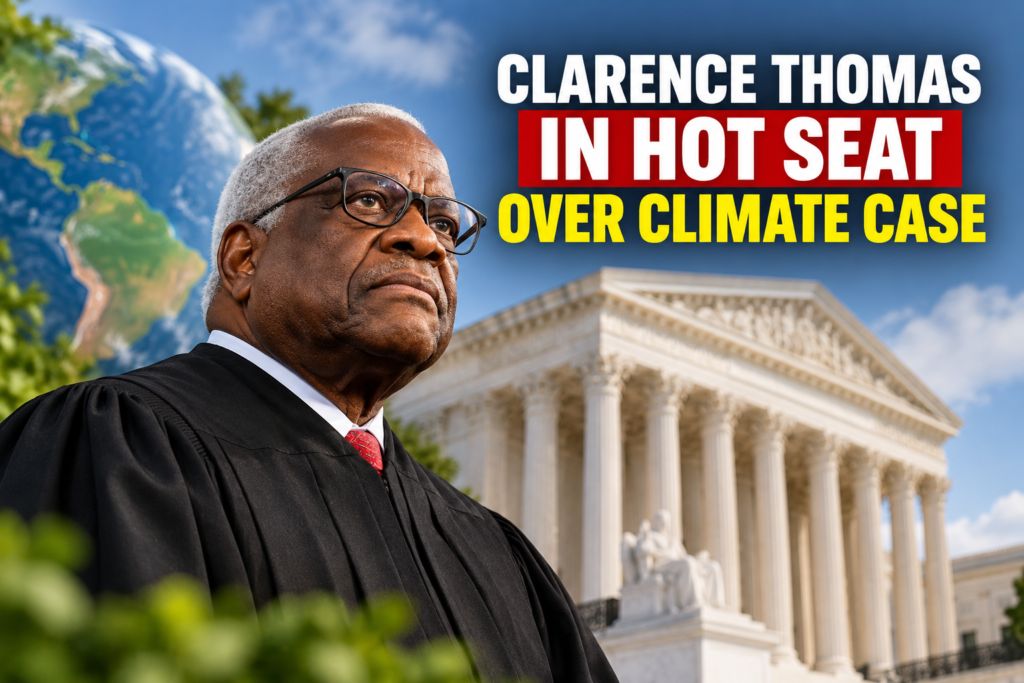
Justice Clarence Thomas is among the most closely watched members of the Supreme Court as it prepares to hear a major climate lawsuit on Monday, October 5. The Clarence Thomas climate case question is not about his general views on environmental rules, which are well known. It is about whether his long-held doubts about federal power over state law could matter when the justices weigh claims against two oil companies.
The lawsuit, Suncor Energy v. County Commissioners of Boulder County, will be the first argument of the court’s new term, according to the City of Boulder. Arguments begin at 10 a.m. Eastern time.
The big question: can Colorado’s Boulder city and county use state law to seek damages from Exxon and Suncor over climate harm, or does federal law block the claims? Thomas has often resisted federal preemption without clear legal text, yet he has also ruled against environmental claims. Justice Samuel Alito will not take part, so a 4-4 tie is possible.
Why the Clarence Thomas climate case matters beyond Colorado
Boulder and Boulder County first sued Suncor and ExxonMobil in April 2018. They accuse the companies of misleading the public about how their products affect the climate, according to a UCLA Law guide to the case. In May 2025, the Colorado Supreme Court ruled 5-2 that the lawsuit could continue. The oil companies then asked the U.S. Supreme Court to step in, and the justices agreed to hear the dispute in February 2026.
The same guide notes that dozens of other local governments and states have filed similar suits in state courts. A ruling for the companies could cut many of them short. A ruling for Boulder could keep them moving.
What each side is telling the court
Boulder’s argument
Boulder says it wants the companies to cover a fair share of local costs tied to events such as fires and floods. CNN reported that the city and county told the justices the suit is not an attempt to solve climate change. Their central legal point is that no clear provision in the Constitution or in a federal law forces state tort claims aside.
The companies’ argument
Exxon and Suncor say climate pollution is a national matter because emissions cross state lines, so federal law should control. They also warn that allowing city after city to sue would create a confusing patchwork of rules. The companies have described the possible damages as a kind of massive carbon tax, CNN reported.
The federal government is backing the companies. The Justice Department filed an unrequested brief last September, Bloomberg Law reported, urging the court to take the case and calling the Colorado ruling seriously wrong. Solicitor General John Sauer also sought permission to argue in support of the oil companies.
How Thomas has handled preemption before
The April decision in Hencely v. Fluor
On April 22, Thomas wrote the court’s opinion in Hencely v. Fluor. An Army specialist injured in Afghanistan sued a military contractor under state law, and the contractor said federal law blocked the suit. In the official opinion, the court sided with the soldier. Thomas was joined by Justices Sotomayor, Kagan, Gorsuch, Barrett and Jackson. Alito dissented, joined by Chief Justice Roberts and Justice Kavanaugh.
The opinion held that nothing in the Constitution, a federal statute or earlier rulings supported blocking the suit. Boulder’s lawyers lean on that reasoning, CNN reported.
Why environmental groups see an opening
CNN noted that Justice Neil Gorsuch, with Thomas joining, wrote a 2019 opinion rejecting a federal-law challenge to Virginia’s uranium mining ban. Kirti Datla of Earthjustice told CNN that both justices have rejected vague arguments about a law’s purpose. Appellate lawyer Deepak Gupta said the lack of a specific legal hook for the companies’ position could trouble them.
Still, no one is treating a Thomas vote for Boulder as certain. CNN described his record on wetlands, power plant emissions and other environmental disputes as consistently unfavorable to environmental groups. John Yoo, a University of California, Berkeley law professor who backed Exxon in a brief, told CNN that Thomas and Gorsuch could side with the companies if they read the Clean Air Act as keeping national-level pollution in federal hands, or if they weigh national security and foreign policy concerns.
Alito’s recusal and the chance of a tie
Justice Alito removed himself from the case on September 28, according to an Associated Press report. A court letter gave no reason. The AP said Alito does not own Suncor or Exxon shares but has disclosed holdings in other oil companies, including ConocoPhillips and Phillips 66.
CNN reported that Alito told Bloomberg News he considered recusal prudent but not required. With eight justices left, a 4-4 split is possible. That result would leave the Colorado ruling in place without creating a national precedent, CNN reported.
Other ways the justices could decide
The court may not reach the main question at all. A Congressional Research Service primer says Boulder argues the companies lack standing and that the court lacks jurisdiction because the Colorado ruling was not a final judgment. You can read the full CRS report for the details. CNN also noted the justices could send the case back to state courts. Monday’s session is an argument only, and a decision will come later.
Key Facts at a Glance
| Detail | What is verified |
|---|---|
| Case | Suncor Energy v. County Commissioners of Boulder County |
| Argument | Monday, Oct. 5, 2026, 10 a.m. ET |
| Defendants | Suncor Energy entities and ExxonMobil |
| Lower-court ruling | Colorado Supreme Court, 5-2, May 2025 |
| Core issue | Whether federal law blocks state-law climate claims |
| Recused justice | Samuel Alito (announced Sept. 28) |
| Thomas opinion | Hencely v. Fluor, April 22, 2026, 6-3 |
Questions readers are asking
When will the Supreme Court hear the case?
Arguments are set for Monday, October 5, 2026, at 10 a.m. Eastern time. It is the first case of the new term, according to the City of Boulder.
Who is suing whom, and why?
Boulder and Boulder County are suing Suncor Energy and ExxonMobil. They say the companies misled the public about the climate effects of their products and should help pay for local costs.
Why is Clarence Thomas getting so much attention?
He has often questioned letting federal law override state law without clear legal text, and he wrote the April Hencely opinion on that theme. He has also ruled against environmental groups in other disputes, CNN reported.
Why did Justice Alito step aside?
A court letter gave no reason. The AP reported that he holds shares in oil companies that are not parties to the case, and CNN said he called recusal prudent but not required.
What happens if the justices tie 4-4?
The Colorado Supreme Court’s decision would stand, and Boulder’s lawsuit could continue. A tie would not set a national precedent, CNN reported.