
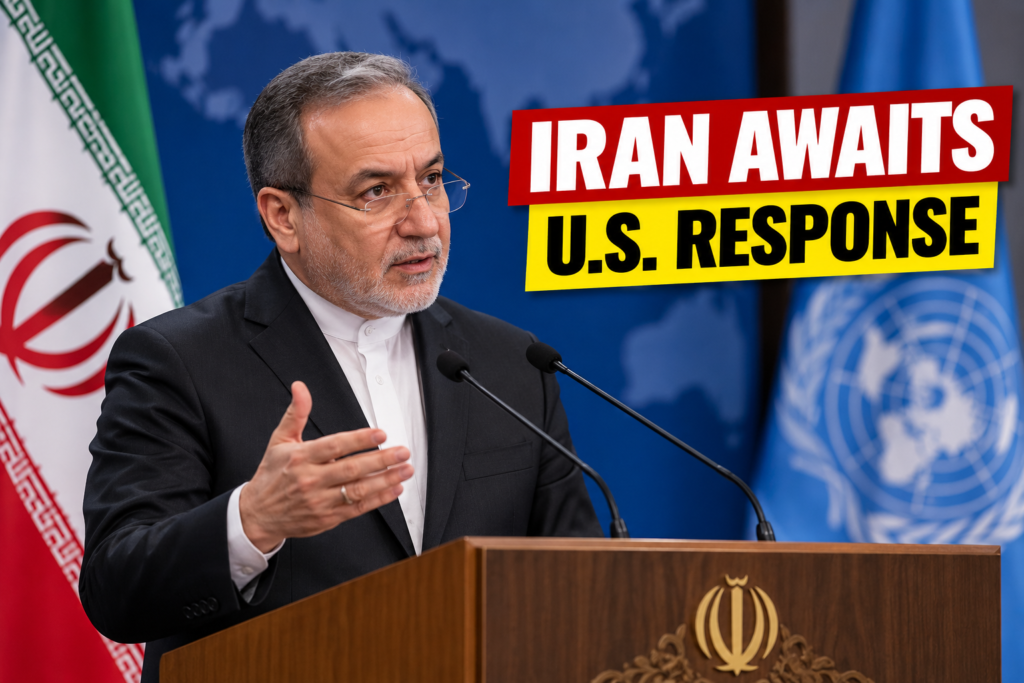
President Donald Trump has rejected Iran’s latest ceasefire proposal to reopen the Strait of Hormuz, dimming hopes for a quick end to months of hostilities between Washington and Tehran. The rejection, which Trump confirmed directly to reporters over the weekend, came just a day after Iran’s foreign minister laid out a detailed seven-day roadmap to restore normal shipping through the vital waterway.
⚡ Quick Summary
Iran offered to reopen the Strait of Hormuz within seven days in exchange for the U.S. releasing frozen funds, lifting oil sanctions and ending its naval blockade. Trump publicly rejected the offer on Saturday, and U.S. officials say he has told aides he expects to resume military strikes on Iran after November’s midterm elections, even as indirect talks continue through Qatar.
What Was in Iran’s Ceasefire Proposal
Iran’s Foreign Minister, Abbas Araghchi, presented the plan to reporters on Friday at the United Nations General Assembly in New York. According to Araghchi, the proposal asked Washington to follow through on commitments it had made under the June 17 Islamabad Memorandum of Understanding, but on a faster timeline.
Those commitments reportedly included releasing roughly $12 billion in frozen Iranian assets, lifting sanctions on Iranian oil exports, and ending the U.S. naval blockade of Iranian ports. Araghchi also said all hostilities, including fighting linked to the conflict in Lebanon, would need to stop during the seven-day window.
Araghchi estimated that if the U.S. met those conditions, it would take four to five days, after which the Strait of Hormuz could reopen to normal maritime traffic and negotiations toward a “final deal” would begin on the seventh day. “The choice now rests with the United States,” Araghchi told reporters, adding that Iran would not accept “coercion, threats or intimidation.”
Why the Strait Matters
The Strait of Hormuz is one of the world’s most important shipping corridors, carrying roughly a fifth of global oil and natural gas trade during peacetime. Its closure since fighting escalated earlier this year has disrupted global energy markets and strained economies across the region, including in neighboring Iraq.
Why Trump Turned Down the Offer
Speaking to reporters as he left the White House on Saturday, Trump confirmed he had passed on the deal. “They made a proposal, but I rejected it,” he said, later adding that he believed Iran was “losing so badly” and was eager to reopen the strait on its own terms rather than Washington’s.
According to reporting from Al Jazeera, which cited unnamed U.S. officials speaking to The Wall Street Journal, Trump remains skeptical that Iran would actually follow through on its side of the agreement. His central demands have not changed: that Iran permanently give up any pursuit of nuclear weapons and restore free passage through Hormuz without further negotiation.
Iran, for its part, has said it will not discuss its nuclear program until its own conditions are met first, leaving the two sides at an impasse over which concessions should come before the other.
“Trump Strait” and Rising Rhetoric
The rejection followed a tense week of escalating rhetoric. Late Friday, Trump posted an image on Truth Social showing a map of the waterway relabeled the “Trump Strait.” Trump has previously said the United States has “total control” over Hormuz and floated designating it U.S. territory, a claim Iran has firmly rejected, insisting it maintains complete control of the strait. Days earlier, Trump told the UN General Assembly he was weighing whether to “annihilate” Iran absent a deal.
Diplomatic Channels Remain Open
Despite the public rejection, both governments say the door to diplomacy has not closed. Qatar, which has served as the key intermediary throughout the conflict, said its foreign minister spoke with Iranian President Masoud Pezeshkian on Friday about de-escalation and conditions for renewed dialogue.
Earlier in the week, U.S. special envoys Jared Kushner and Steve Witkoff held mediated discussions with Iranian counterparts in New York, a meeting Trump himself described as “very good.” A U.S. official told Al Jazeera that Washington is in “no hurry” to formally respond to Iran’s proposal, believing it holds a strong position over the strait.
Pezeshkian, meanwhile, has signaled Iran would prefer to strike a deal before the November elections. “We don’t want it to get to the midterm elections,” he told reporters, according to reporting cited by OAN.
What Could Come Next
Analysts say the outcome of this year’s U.S. midterm elections could shape whether the standoff ends in renewed fighting or a negotiated settlement. Thomas Warrick, a senior fellow at the Atlantic Council, said there is “an enormous amount of scepticism in Washington” that the two countries are close to agreement, and that Iran’s latest offer may at best open the door to further talks over preconditions.
Paul Musgrave, an associate professor of government at Georgetown University in Qatar, said Trump “doesn’t want to end the war on unfavourable terms” and that November’s results will likely shape his next move. If Republicans suffer significant losses, Musgrave said, Trump could turn to “unilateral actions, including perhaps a resumption of warfare” — a scenario he said would let Iran claim a political win against the White House, followed by renewed negotiation so the administration does not appear to be surrendering.
For now, the Strait of Hormuz remains a central flashpoint, and both sides continue to describe indirect, Qatar-brokered talks as constructive even as public statements grow more combative.
Note:
Details in this article are based on statements from Iranian and U.S. officials as reported by multiple news organizations. Some figures, such as the exact terms of Iran’s proposal, have not been independently confirmed by the U.S. government, which has not issued a public response.
Frequently Asked Questions
What is Iran’s seven-day ceasefire proposal?
It is a plan presented by Iran’s Foreign Minister Abbas Araghchi to reopen the Strait of Hormuz within about a week, in exchange for the U.S. releasing frozen assets, lifting oil sanctions, ending its naval blockade and pausing hostilities, including in Lebanon.
Why did Trump reject the proposal?
Trump said he does not believe Iran would follow through on its commitments. His demands remain that Iran permanently abandon any pursuit of nuclear weapons and restore free passage through Hormuz.
Why is the Strait of Hormuz important?
The strait is one of the world’s busiest shipping routes, normally carrying about a fifth of global oil and natural gas trade. Its closure has disrupted energy markets and regional economies.
Are the U.S. and Iran still negotiating?
Yes. Talks are continuing indirectly through Qatar, and U.S. envoys Jared Kushner and Steve Witkoff met Iranian counterparts in New York this past week, in discussions Trump called “very good.”
Could the conflict escalate again?
Analysts say it’s possible. U.S. officials have reportedly said Trump expects to resume military strikes on Iran after November’s midterm elections if no deal is reached beforehand.