
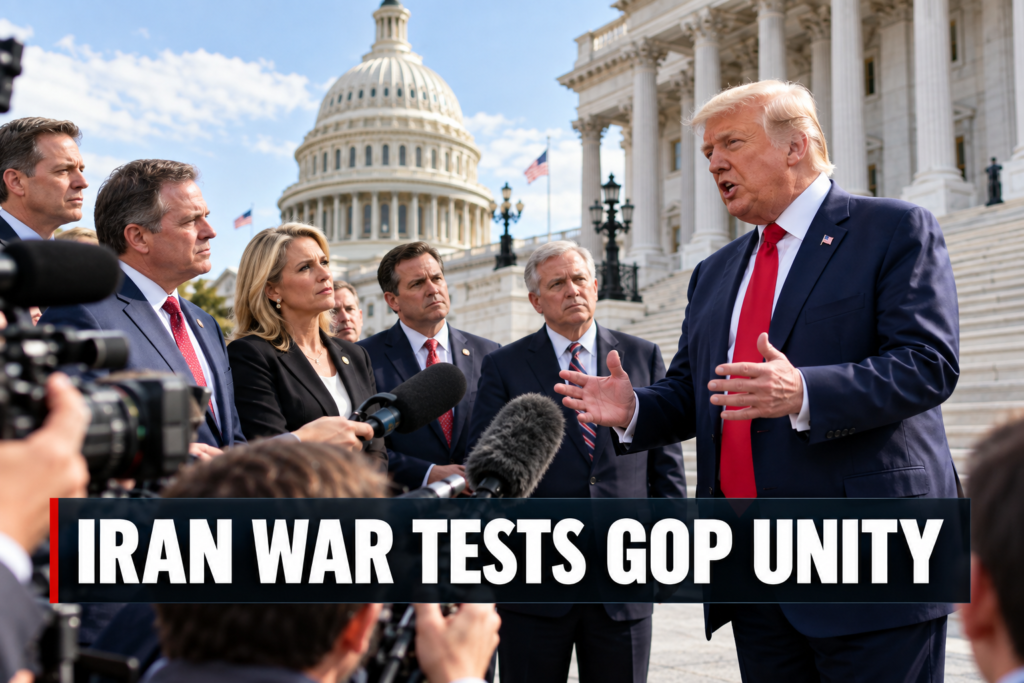
A rising number of Republican candidates are putting daylight between themselves and President Donald Trump over the war in Iran, arguing that the seven-month-old conflict has become a political liability heading into the Iran war midterms fight this November. As gasoline and diesel prices climb and polls show cooling GOP enthusiasm for the war, party strategists say the defections are likely to grow rather than fade before Election Day.
GOP Candidates Break Ranks as the War Drags On
Senate and House candidates in some of the most competitive races in the country are now openly calling for an end to the war, a marked shift from earlier in the year when most Republicans stood firmly behind the president’s approach. In Iowa, Senate nominee Rep. Ashley Hinson said this week that the conflict needed to reach “a successful and immediate end,” pointing to the toll rising fuel and grocery costs are taking on her constituents. Michigan Senate candidate and former congressman Mike Rogers made a similar appeal in a campaign ad filmed inside a grocery store, telling voters the war “needs to end, and end quickly.”
Ohio Sen. Jon Husted, who is defending his seat in a tight race this year, told POLITICO that ending the war quickly was necessary to bring down gas prices. Michigan gubernatorial candidate Rep. John James struck a similar note, telling reporters that the country needs to “end this war quickly” because, in his words, war is terrible and nobody benefits from it lasting longer than necessary.
The Iran war midterms fight is now a defining test for the GOP: rising fuel prices, a slim majority of Republicans still calling the war worthwhile, and a third House vote to limit Trump’s war powers all point to a party trying to manage a conflict that has outlasted its early public support.
Key Facts
| Measure | Figure |
|---|---|
| Length of the Iran war (as of late Sept. 2026) | Roughly seven months |
| Added inflation from the war (CBO, Q2 2026) | +2.3 points, on a 5.3% annualized rate |
| Regular gasoline price increase since war began | About 52%, near $4.48/gallon |
| Diesel price increase since war began | About 71% |
| Republicans calling the war “worthwhile” (YouGov, Sept.) | 53%, down from 68% in April |
| House GOP votes to limit war powers | Third such vote since the war began |
Why the Iran War Midterms Fight Is Reshaping the GOP
Republican strategist Brian Darling, a former counsel to Sen. Rand Paul, said the defections are driven largely by simple electoral math. Candidates in close races, he said, want to reassure voters that they share their frustration with the war’s cost, both financial and political. Darling traces much of that frustration to the war’s effect on energy markets, particularly disruptions to shipping through the Strait of Hormuz, the narrow waterway that carries roughly a fifth of the world’s crude oil.
Inflation and Gas Prices Fuel Discontent
A Congressional Budget Office report released in mid-September found the war added 2.3 percentage points to the annualized inflation rate in the second quarter of 2026, which stood at 5.3%. The U.S. Energy Information Administration has tracked regular gasoline prices rising roughly 52% since the war began, to around $4.48 a gallon, while diesel has climbed about 71% over the same stretch. A Reuters/Ipsos poll from late August found that 47% of voters named the cost of living as the single most important factor in how they will vote this November, and the same survey found only about a quarter of Americans consider the war worthwhile.
Polling also shows the erosion is happening specifically among Republican voters. A YouGov survey conducted Sept. 18–21 found that 53% of Republicans still called the decision to go to war the right one, down 15 points from 68% in April. A separate CNN poll conducted by SSRS found Republican approval of the war falling from 73% in March to 60% by mid-September, with a majority of Republicans under 45 now disapproving.
Anti-War Sentiment Grows on Capitol Hill
The shift is not confined to the campaign trail. Earlier this month, Iowa Reps. Zach Nunn and Mariannette Miller-Meeks, both facing competitive reelection races, voted for the first time in favor of a resolution restricting Trump’s ability to continue combat operations in Iran without congressional authorization. Nunn, an Air Force Reserve colonel and combat veteran, said in a statement that sustained operations now needed congressional sign-off given that the negotiating window had closed. Miller-Meeks, a two-decade Army veteran, wrote that Americans do not want another open-ended war. Reps. Thomas Massie, Brian Fitzpatrick, Warren Davidson, Tom Barrett and Nancy Mace also backed the measure, marking the third time the House has voted to rein in the president’s war powers since the conflict began.
A Fox News poll conducted Sept. 11–14 found 71% of all voters, including 43% of Republicans, believe the administration lacks a clear strategy for ending the war. A YouGov poll taken days later found 52% of Americans expect the conflict to last at least another year, a share that has climbed steadily from 32% in March.
Trump Holds Firm While Allies Seek Distance
Trump has largely dismissed concerns about pump prices, at one point calling them “a very inexpensive price to pay” for the administration’s actions. Speaking at the United Nations General Assembly last week, he raised the possibility of far more aggressive action against Iran while also saying he had a “very good” recent meeting with Iranian mediators and suggesting the war could wind down after the midterms. He has also floated banning diesel exports as a way to ease domestic fuel costs.
Republican strategist Doug Heye said the combination of an unclear endgame and sustained price increases has moved well past being a temporary political headache. According to strategists tracking the races, the defections remain a minority position within the party for now, but the trend lines suggest that more candidates will follow suit as November approaches, particularly in states where fuel and grocery costs are weighing heavily on voters. Coverage of the report by the original TIME reporting notes that Democrats have led most 2026 generic congressional ballot polling, adding to Republican anxiety about the war’s fallout.
Frequently Asked Questions
Why are Republicans distancing themselves from Trump on Iran?
Many GOP candidates say rising gas, diesel and grocery prices tied to the war are hurting their standing with voters ahead of the midterms, and some also cite the lack of a clear plan to end the conflict.
How has the Iran war affected gas prices?
According to the U.S. Energy Information Administration, regular gasoline prices have risen about 52% since the war began, while diesel prices are up roughly 71% over the same period.
Which Republicans in Congress have voted to limit Trump’s war powers on Iran?
Reps. Zach Nunn, Mariannette Miller-Meeks, Thomas Massie, Brian Fitzpatrick, Warren Davidson, Tom Barrett and Nancy Mace have all voted for resolutions restricting the president’s ability to continue combat operations without congressional approval.
Do most Republican voters still support the war?
A slim majority, 53%, still called the war the right decision as of late September, but that is down sharply from 68% in April, according to YouGov polling.
Has President Trump signaled when the war might end?
Trump has given shifting signals, at times threatening to escalate the conflict further and at other times suggesting it could end after the midterm elections, while also floating a possible ban on diesel exports to ease fuel costs.