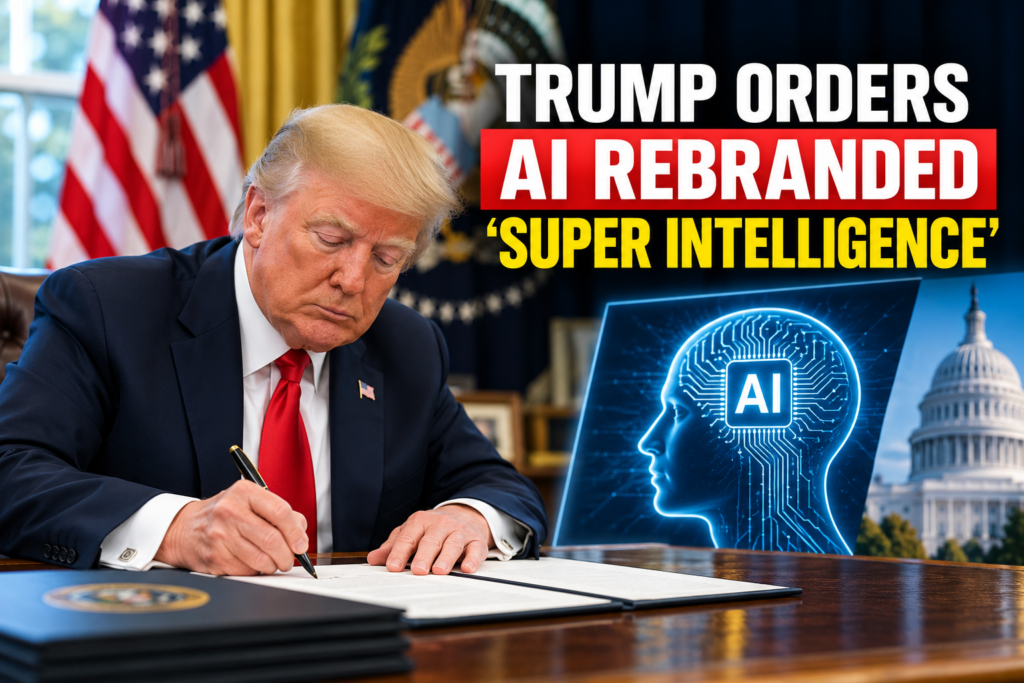
President Donald Trump signed a Super Intelligence executive order on Tuesday, September 29, 2026, directing the federal government to replace the term “artificial intelligence” with “Super Intelligence” across the executive branch. The order followed a White House summit with leading technology executives, who also signed a separate voluntary accord.
What the Super Intelligence executive order requires
The order is titled “Inaugurating the Era of Super Intelligence.” It tells federal departments and agencies to use “Super Intelligence” and “SI” in place of “artificial intelligence” and “AI,” to the maximum extent permitted by law.
The rule covers official correspondence, public communications, websites, reports, policy documents and other non-statutory materials. According to the White House, agencies should also no longer acknowledge the older terms.
The order does not rewrite existing law. For now, it applies the current statutory definition of artificial intelligence in Title 15 of the U.S. Code to the new term. In practice, the same technologies are covered, and the label is what changes.
The order also gives a job to the assistant to the president for science and technology. That official must propose a federal definition of SI and recommend any further executive action needed to carry out the new terminology.
Key facts at a glance
| Detail | What we know |
|---|---|
| Date signed | Tuesday, September 29, 2026 |
| Order title | Inaugurating the Era of Super Intelligence |
| Applies to | The executive branch, within limits of the law |
| New terms | “Super Intelligence” and “SI” |
| Legal definition | Existing Title 15 definition applies for now |
| Next task | Science and technology adviser to propose a federal SI definition |
| Companion document | White House Accord on Super Intelligence (voluntary) |
In brief
Federal agencies must now say “Super Intelligence” instead of “artificial intelligence” in official materials. The order changes the name, not the legal definition, and it does not create new rules for the industry. Tech leaders separately signed a voluntary accord that Trump called morally binding.
Why the White House made the change
Trump argued in the order that “artificial intelligence” no longer reflects how quickly the technology is advancing. He wrote that “Super Intelligence” better captures its promise and potential.
The order also says modern systems increasingly amplify human ingenuity and open new forms of creativity. It describes them as the start of a new era.
A White House fact sheet on the order adds that the new name is meant to show what the technology can do. It says the older term wrongly suggests the systems only imitate or automate human intelligence.
The move follows Trump’s remarks at the United Nations General Assembly last week. There, he publicly called for dropping the old term and said the country that leads in superintelligence comes out ahead.
The White House Accord on Super Intelligence
Before signing the order, Trump hosted technology leaders at the White House. Media reports say attendees included Elon Musk, Mark Zuckerberg and Nvidia CEO Jensen Huang. At the end of the gathering, participants signed a document called the White House Accord on Super Intelligence.
GovConWire reported that leaders of six technology companies committed to safety controls and audits for frontier models under the accord.
The accord is voluntary. Trump said it is “morally binding” for the executives who signed it. He added that they almost viewed it as a separate kind of constitution. Trump has opposed formal guardrails on the technology.
Reactions from Washington and the tech industry
House Speaker Mike Johnson said participants focused on balancing the interests of the American people, advancing the technology and keeping the United States ahead of China. He described the accord as a statement of principles and standards with voluntary industry commitments. In short, he said, it calls for strong internal controls and layers of internal and external review.
Meta CEO Mark Zuckerberg wrote on X that he saw the summit as a significant positive step. He said the leaders of every major American lab had committed to internal controls and multiple layers of audits and reviews, which should give people more confidence that the systems work as intended.
Trump also told reporters that the United States holds a very big lead over other nations, including China, and plans to keep it.
What the order does not do
The Super Intelligence executive order is about terminology. The National Desk reported that it would not itself create a new regulatory framework for the industry. Trump has dismissed calls for sweeping new federal rules.
It also reaches only the executive branch and, by its own wording, only as far as the law allows. Governments and technology companies are still debating how to govern fast-moving systems, and this order does not settle that debate.
What happens next
The next step is the federal definition. The president’s science and technology adviser must propose one and identify any extra executive action needed. The sources reviewed for this article do not give a deadline for that work.
Until then, the existing legal definition stays in place, and agencies are expected to adjust their websites, reports and public statements to the new wording.
Frequently asked questions
What does the Super Intelligence executive order do?
It directs executive branch agencies to use “Super Intelligence” and “SI” instead of “artificial intelligence” and “AI” in official correspondence, public communications, websites, reports and other non-statutory materials.
Does the order change the legal definition?
No. For now, the existing statutory definition of artificial intelligence in Title 15 of the U.S. Code applies to Super Intelligence.
What is the White House Accord on Super Intelligence?
It is a voluntary document signed by technology leaders after the White House summit. Reports describe commitments to internal controls, audits and reviews of advanced systems.
Is the accord legally binding?
The accord is described as voluntary. Trump called it “morally binding” for the executives who signed, but that is not a legal requirement.
Who will define Super Intelligence for the government?
The assistant to the president for science and technology must propose a federal definition and recommend any further executive actions needed.