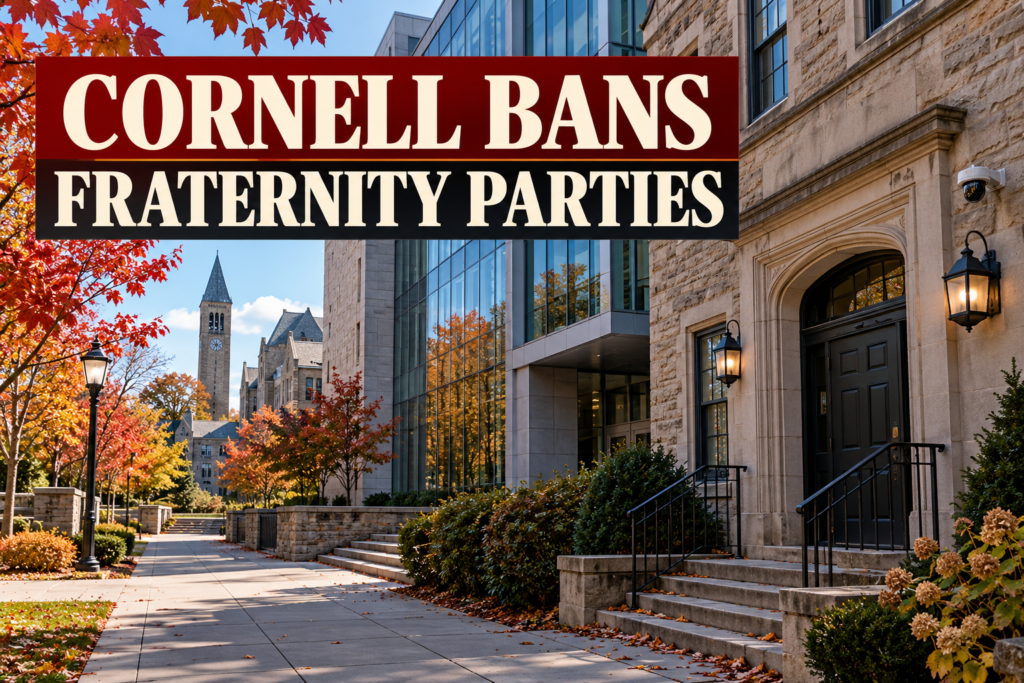
Cornell University has announced a Cornell fraternity party ban that suspends parties and social events at fraternity houses for the rest of the 2026-27 school year. President Michael Kotlikoff laid out the step in a letter to the campus on Tuesday, along with plans to add experienced investigators for sexual assault cases, NBC News reported.
Quick summary
The Cornell fraternity party ban pauses in-house fraternity events through the academic year, hiring trauma-informed criminal investigators, and working with state police. The moves follow a lawsuit by a former student, identified as Jane Doe, over an alleged 2024 assault. The seven men named in the suit deny the allegations, and none of the claims has been proven in court.
What the Cornell Fraternity Party Ban Covers
According to CNN, Kotlikoff’s letter suspends all parties and social events at the school’s fraternity houses until the end of the academic year. The university says the pause gives it time to decide how and whether fraternity life can continue safely on campus.
The rule comes with a firm penalty. Any fraternity that holds an in-house party or social event will face an immediate emergency suspension, Kotlikoff wrote. Newsweek reported that the suspension applies to houses under the Interfraternity Council.
The university also plans to work with students and faculty on “safe social alternatives,” MS NOW reported.
Key Facts at a Glance
| Detail | What is known |
|---|---|
| Announced | Tuesday, Oct. 13, 2026 |
| Announced by | President Michael Kotlikoff |
| Main change | No parties or social events at fraternity houses through the 2026-27 academic year |
| Penalty | Immediate emergency suspension for violators |
| Other steps | Trauma-informed investigators, more survivor support staff, review led by Sally Yates |
| Legal status | Civil lawsuit filed in September; state investigation ongoing |
New Investigators and Survivor Support
Beyond the social restrictions, Cornell said it will bring on “experienced, trauma-informed criminal investigators” to review sexual assault reports, as NBC News noted. The university is also working to let the New York State Police investigate assault allegations that arise on campus.
MS NOW reported that officials also intend to hire more staff to support survivors and to work on changing the social culture at Cornell.
Kotlikoff said the problem reaches beyond fraternities. In his letter, he described campus sexual assault as a wider cultural issue and said drug and alcohol abuse contribute to it, CNN reported.
The Lawsuit Behind the Changes
The announcement follows a civil lawsuit filed last month by a former student who is identified only as Jane Doe. NBC News said the suit names several parties, including the university, the Chi Phi fraternity, her sorority and seven former Chi Phi members. Her allegations involve an incident in October 2024.
Newsweek reported that all seven men named in the suit have denied the allegations. These claims remain allegations, and a court has not ruled on them.
The Associated Press, in a report carried by WPXI, said Cornell suspended the Chi Phi chapter indefinitely and disciplined or expelled some students after the woman came forward. The university has declined to give specifics, citing student privacy rules.
State Officials and an Outside Review
State officials have also stepped in. The AP report said Gov. Kathy Hochul signed an executive order naming the office of Attorney General Letitia James as special prosecutor. That followed the Tompkins County district attorney’s decision to reopen the investigation after reviewing new information in the lawsuit. Under the order, the attorney general would oversee the inquiry and, if warranted, present evidence to a grand jury.
Separately, Cornell asked Sally Yates, a former acting U.S. attorney general, to lead an independent review of how the university prevents and responds to sexual harassment, assault and related misconduct. Newsweek noted that the review will examine Cornell’s policies, practices and resources.
Kotlikoff also apologized to Jane Doe in his announcement. Bloomberg reported that he acknowledged women on campus still question whether they are safe, and that the university must act on where it has fallen short.
What Comes Next for Cornell
Several questions remain open. The university has not said how the review of fraternity life will be carried out or what could follow the Cornell fraternity party ban once the academic year ends. The criminal inquiry led by the attorney general’s office has no announced timeline, and the civil case is still at an early stage.
For students, the immediate effect of the Cornell fraternity party ban is simple: no in-house fraternity parties this year, with penalties for chapters that break the rule. Readers who want the full details can consult the linked reports and the university’s own statement.
Frequently Asked Questions
How long does the Cornell fraternity party ban last?
It runs for the rest of the 2026-27 academic year, while the university reviews whether and how fraternity life can continue safely.
What happens if a fraternity ignores the Cornell fraternity party ban?
Kotlikoff wrote that any fraternity holding an in-house party or social event will receive an immediate emergency suspension.
What other changes did Cornell announce?
The university plans to add experienced, trauma-informed criminal investigators, hire more survivor support staff, and work with New York State Police on campus assault allegations.
Who is Sally Yates and what is her role?
She is a former acting U.S. attorney general. Cornell asked her to lead an independent review of how it responds to sexual harassment, assault and misconduct.
Have the allegations been proven?
No. The claims appear in a civil lawsuit, and the seven men named in it have denied them.
If you or someone you know has been affected by sexual violence, RAINN offers confidential support at 1-800-656-4673.