
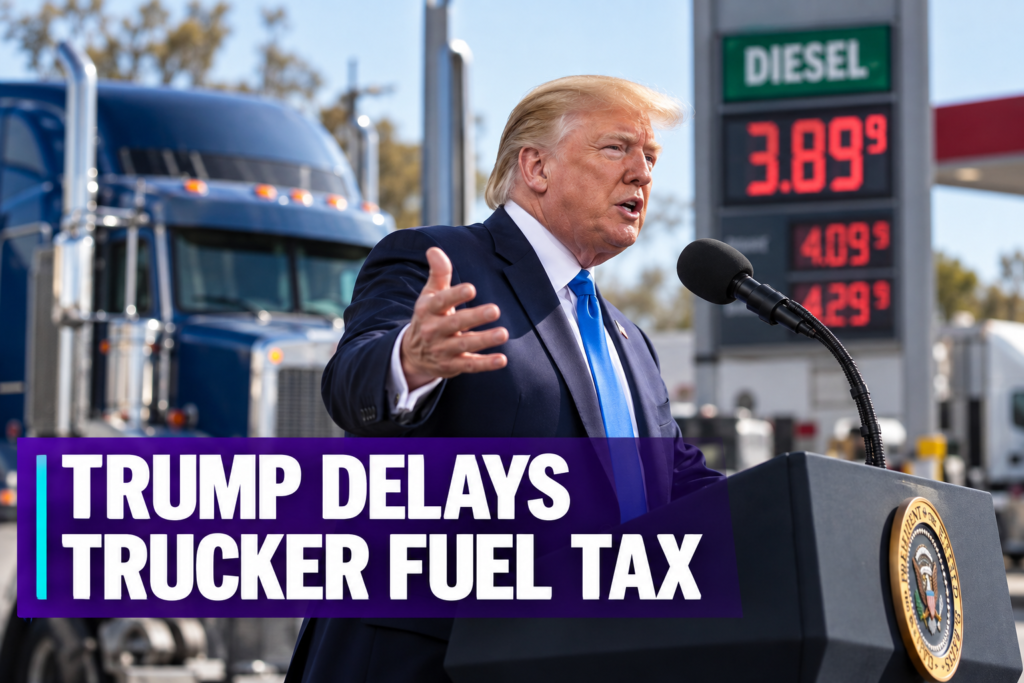
President Donald Trump signed an executive order on Monday, Oct. 5, 2026, that creates a diesel tax deferral for fuel that is normally limited to off-road use. Signed on stage at a campaign rally in Grand Island, Nebraska, the order temporarily lets red-dyed diesel be used on highways and postpones the federal tax that would normally apply, with relief aimed at truckers, farmers and other heavy diesel users.
The diesel tax deferral postpones, rather than cancels, the 24.4-cent federal diesel tax on dyed fuel used on roads. The deferral carries no interest or penalties and runs through the end of 2026. The Treasury Department has been asked to look at ways to remove the obligation, and the tax is still owed if nothing changes. The move comes as diesel prices sit near record highs, weeks before the midterm elections.
What the Diesel Tax Deferral Actually Does
According to Nebraska radio station KRVN, the order directs the Treasury Department to defer the federal excise tax that normally applies when dyed diesel is burned on public roads. The White House said the diesel tax deferral stays in place for the rest of 2026 and does not add interest or penalties.
At the rally, Trump described the plan as a way to waive the off-road requirement so that anyone could buy tax-free dyed diesel. The text of the order is narrower than that description. Nebraska Public Media reported that the order does not eliminate the tax. It postpones payment on dyed diesel used on highways.
Euronews, which reviewed the order, reported that the deferral covers use from Oct. 5 through Dec. 31. It also reported that the order asks Treasury Secretary Scott Bessent to explore ways, including legislation, to remove the obligation to pay the deferred amounts. Without such a step, the money would come due after the relief period ends. Euronews also said the order leans on a law that lets Treasury delay tax deadlines after disasters or military action, and gives Bessent five days to decide who qualifies. Other reports reviewed did not detail that legal basis, so the exact eligibility rules for the diesel tax deferral remain to be confirmed.
The White House put the federal diesel tax at 24.4 cents per gallon, which works out to about $60 on a 250-gallon fill. It said savings could be larger in states that take similar steps.
How Red-Dyed Diesel Differs From Regular Diesel
Red-dyed diesel is nearly identical to the diesel sold for trucks. As a Fox explainer on the fuel describes it, the dye works as a tax-enforcement marker showing that highway taxes were not paid. Using it on public roads normally counts as tax evasion and can bring heavy fines, even though the fuel itself is not materially different.
That is why farm equipment and construction machinery have long used it. The new order changes the federal side of that arrangement for a limited time. KRVN noted that state diesel taxes and state enforcement are separate matters. The White House said state governors may choose to follow with their own steps, such as relaxing inspections or dropping state taxes.
| Action | Executive order signed by President Trump |
|---|---|
| Date and place | Oct. 5, 2026, Grand Island, Nebraska |
| What it does | Defers the federal tax on dyed diesel used on roads |
| Federal diesel tax | 24.4 cents per gallon (about $60 on 250 gallons) |
| Relief period | Through Dec. 31, 2026, with no interest or penalties |
| Is the tax canceled? | No. Treasury was asked to look at ways to remove it |
The Fuel Prices Behind the Order
Diesel has been unusually expensive this year. Fox Business reported that the AAA national average reached a record $5.85 a gallon on Sept. 4, passing the previous high from June 2022. Euronews later reported that the average stood at $6.32 on Monday, just under a record of $6.53 set on Sept. 22, and more than 70% above a year earlier.
Nebraska has felt the pressure too. Nebraska Public Media said Gov. Jim Pillen wrote to Trump that diesel was averaging a record $6.21 a gallon in the state. He also asked for a 90-day pause on diesel exports. The order signed on Monday does not address exports.
The causes are described differently. Euronews linked the price rise to the Iran war, which began in February and disrupted shipping through the Strait of Hormuz, along with Russian limits on fuel exports. The White House statement did not mention Iran. It pointed instead to the Russia-Ukraine war, limited refining capacity worldwide, and refinery closures in some states.
Who May Benefit, and What Analysts Say
The practical effect of the diesel tax deferral depends on who uses the fuel. In its coverage of the signing, the Associated Press noted that Patrick De Haan of GasBuddy had said such a move could save money for on-road users, but not for farmers, who already use dyed diesel in their equipment. De Haan has also argued that supply, not taxes, is the central problem.
Rystad Energy analyst Preben Sørli offered a similar view in the Fox explainer. Wider access to tax-exempt diesel could help some eligible users, he said, but it would not change the underlying wholesale price.
Farm groups have responded positively. Euronews quoted Zippy Duvall, president of the American Farm Bureau Federation, who said every cent per gallon matters to those running fleets of grain trucks or hauling cattle. Harvest season is underway in much of the country, which adds to the demand for diesel.
What Happens Next
Several details about the diesel tax deferral are still open. Treasury must decide which taxpayers qualify, and it is not yet clear how the deferred amounts would be handled if Congress or the administration moves to cancel them. Anyone who plans to use dyed diesel on public roads should wait for official guidance from the Treasury Department, the IRS and their state before changing fueling habits.
The timing is politically significant. AP reported that Trump signed the order about four weeks before the midterm elections, during a rally for Nebraska Republicans. Oil markets, meanwhile, have eased slightly. Euronews reported that Brent crude fell below $100 a barrel on Tuesday as Gulf exports, excluding Iran, recovered toward pre-war levels.
Frequently Asked Questions
What did President Trump sign on Oct. 5?
He signed an executive order at a rally in Grand Island, Nebraska. It temporarily allows red-dyed diesel to be used on highways and defers the federal excise tax on that fuel through the end of the year.
Does the order cancel the federal diesel tax?
No. It postpones payment. The order asks Treasury to look at ways to remove the obligation, including legislation, but the deferred tax is still owed unless that happens.
How much is the federal diesel tax?
The White House said it is 24.4 cents per gallon, or about $60 on a 250-gallon fill.
How long does the diesel tax deferral last?
The deferral runs through Dec. 31, 2026, without interest or penalties, according to the White House and Euronews.
Will the order lower diesel prices?
It may reduce costs for eligible on-road users, but Rystad Energy’s Preben Sørli said it would not change the underlying wholesale diesel price.