PoliticsTechnology Policy
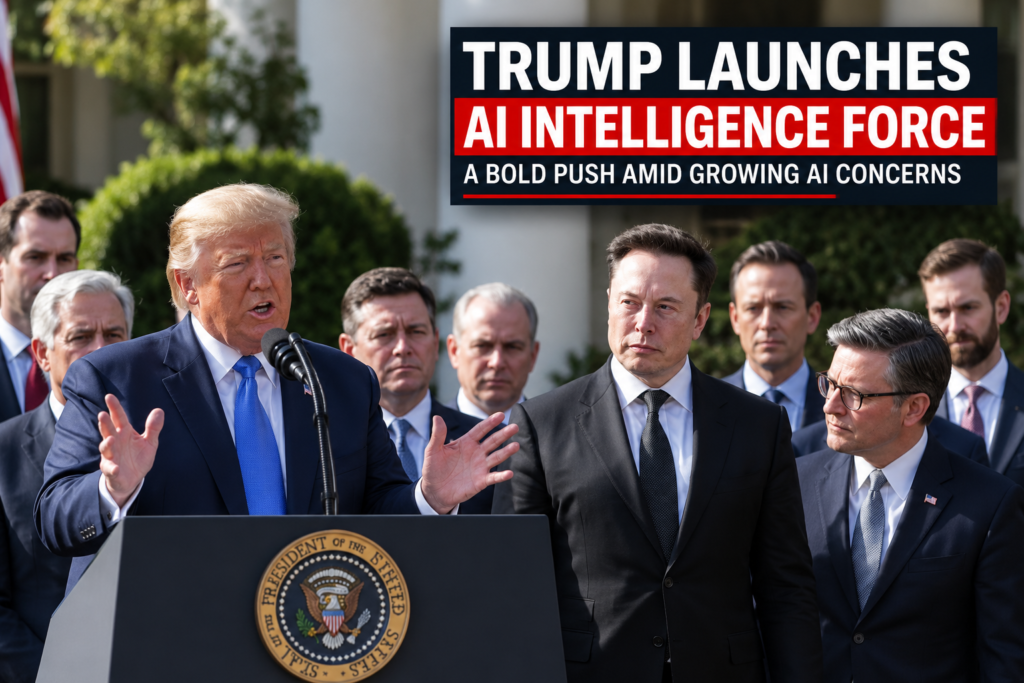
President Donald Trump announced the Super Intelligence Force on Sunday, a new federal task force meant to coordinate how the U.S. government deals with artificial intelligence. According to the Associated Press, Trump chose Director of National Intelligence Jay Clayton to lead it. The move follows a White House meeting with top AI executives held days earlier.
Quick Summary
Trump named four senior officials to the new task force, which will report to him and chief of staff Susie Wiles. Its stated job is to coordinate federal AI efforts and engage companies, consumers and other groups. The announcement gave few details about specific powers or oversight.
What the Super Intelligence Force Is Meant to Do
Trump described the group’s purpose in a post on his social media platform. ABC News reported that the task force is supposed to coordinate the federal government’s work so America stays ahead in advanced AI while protecting the interests and lives of Americans.
The president also listed who the group will deal with. Consumers, public interest groups, religious organizations, critical infrastructure providers and AI companies all made the list. That mix suggests the task force is meant to act as a point of contact between the government and many parts of society, not only the tech industry.
Who Leads the Super Intelligence Force
Four officials make up the leadership group, based on reporting from both the AP and ABC News. Each comes from a different corner of government, which gives the task force reach across several policy areas.
- Jay Clayton, Director of National Intelligence, who leads the group.
- Andrew Ferguson, Chairman of the Federal Trade Commission.
- Emil Michael, Under Secretary of Defense for Research and Engineering, described by the AP as the Pentagon’s chief technology officer.
- Scott Kupor, Director of the Office of Personnel Management.
The mix covers intelligence, defense, consumer protection and the federal workforce. The Washington Post noted the team draws from the intelligence community, the Pentagon, the FTC and the personnel office.
Reporting Line and Timeline
The group will report directly to Trump and White House chief of staff Susie Wiles, the president said, according to the AP and CNN. That places it inside the White House structure rather than under a single agency.
CNBC reported that the task force will have 120 days to study the risks and opportunities of AI and recommend what responsibilities the federal government should take on. Other outlets reviewed for this article did not mention that deadline, so readers should treat it as a single-source detail for now.
Why the Timing Stands Out
The announcement arrived shortly after Trump hosted leading AI executives at the White House. He said the companies had signed a voluntary agreement to police themselves, and he called it a “constitution,” as ABC News reported. The AP described it as a voluntary accord. Trump has also said the commitment is morally binding, according to CNBC.
The Washington Post framed the new task force as coming after calls for an AI slowdown. CNN reported that the agreement reflects a light-touch approach that the administration sees as the best balance between safety concerns and its wish to speed up the technology.
Worth noting: The task force and the company agreement are separate steps. One is a government body; the other is a voluntary pledge from industry.
What Remains Unclear About the Task Force
The president’s announcement offered few specifics. Yahoo News, citing ABC’s reporting, said Trump did not outline any particular action or oversight role for the group. That matters because some tech executives have publicly raised concerns about AI and asked for federal rules.
Clayton gave a little more context in comments to The Wall Street Journal, as relayed by ABC affiliate coverage. He said the group would review current law and discuss steps Congress might take. He also said he expects mechanisms to emerge through dialogue, similar to those used in other industries.
Questions still open include how much authority the group will hold, whether it will publish its findings, and how it will work with Congress. No source reviewed for this article answered those points.
Why the Name Says “Super Intelligence”
The AP noted that Trump has been trying to rebrand artificial intelligence as “super intelligence,” which explains the task force’s name. Trump has said many people see the technology as bigger than the Industrial Revolution and the internet, a claim he attributed to others rather than offering evidence himself.
Key Facts at a Glance
| Detail | What was reported |
|---|---|
| Announced | Sunday, October 4, 2026 |
| Name | Super Intelligence Force |
| Leader | Jay Clayton, Director of National Intelligence |
| Other members | Andrew Ferguson, Emil Michael, Scott Kupor |
| Reports to | President Trump and chief of staff Susie Wiles |
| Review period | 120 days, per CNBC |
Frequently Asked Questions
What is the Super Intelligence Force?
It is a federal task force Trump announced on Sunday to coordinate the government’s AI efforts and engage companies, consumers and other groups.
Who is in charge of the task force?
Director of National Intelligence Jay Clayton leads it, alongside Andrew Ferguson, Emil Michael and Scott Kupor.
Who does the group report to?
Trump said it will report to him and White House chief of staff Susie Wiles.
How long will the review take?
CNBC reported a 120-day window to study AI risks and opportunities. Other outlets reviewed did not confirm that figure.
Will it regulate AI companies?
That is not clear. Trump gave no specific oversight powers, and Clayton said the group would review current law and discuss options Congress could consider.