
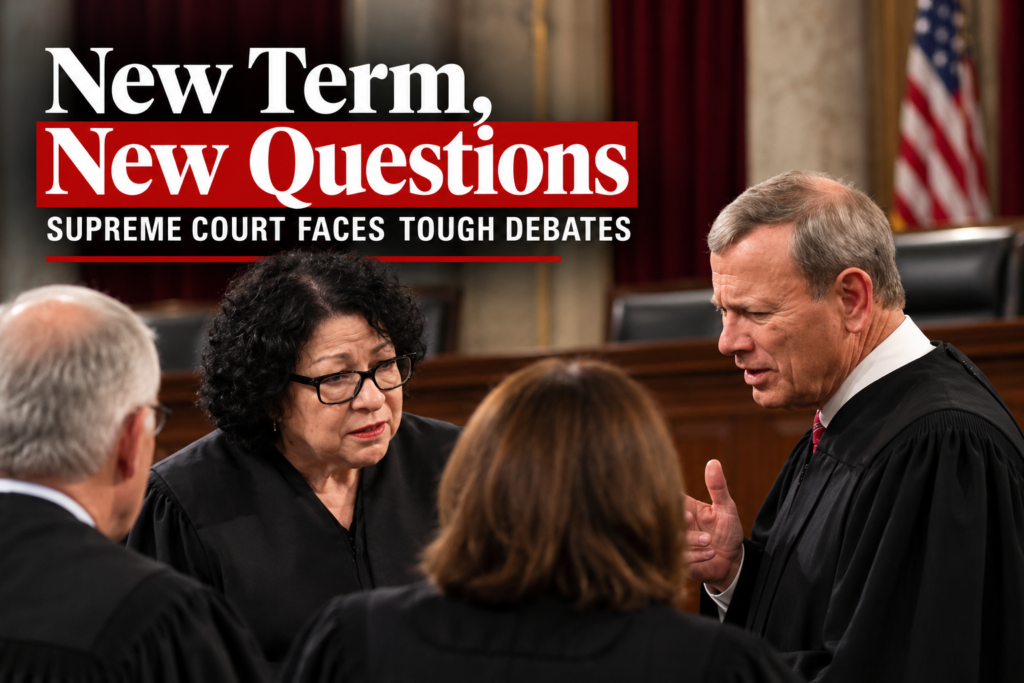
The Supreme Court new term opens Monday, Oct. 5, 2026, and the justices return to a calendar packed with disputes over climate lawsuits, gun laws, voter registration and religious liberty. They also return amid record-low public approval, rising security worries and fresh public criticism from the president who appointed three of them.
The court begins its 2026-27 session with a climate case from Boulder County, Colorado, then moves on to cases about AR-15 bans, proof of citizenship for voter registration and a religious preschool.
Gallup measured public approval at 33% in July, the lowest in its 26-year trend.
Justice Samuel Alito says he is staying for the term, and Justice Amy Coney Barrett has described serious threats to the justices.
Why the Supreme Court new term begins with a climate case
Under federal law, the court’s term starts on the first Monday in October. This year, that day is also the first day of arguments. SCOTUSblog reported that the justices will hear seven cases over five days in the October sitting, with Suncor Energy v. Commissioners of Boulder County going first.
The case asks whether federal law blocks state-law claims over harm allegedly caused by worldwide greenhouse gas emissions. Boulder and its county are suing Suncor and Exxon Mobil, and Bloomberg Law reported that the outcome could affect similar suits brought by cities and states.
The Trump administration supports the oil companies and has asked to take part in the argument. Watchdog groups have urged Justice Alito to step aside from the case because of his oil-industry stock holdings, according to the same report.
Guns, voting and religion are also on the docket
The climate dispute is only one of several cases that will draw national attention. According to a Federalist Society preview of the term, the justices will consider a Second Amendment challenge to bans on AR-15-style rifles, a Colorado dispute over religious schools in a state preschool program, and a voting case involving proof-of-citizenship rules.
Voting rules before and after the midterms
The voting case comes from Arizona. Law360 described two questions: whether the state may require documentary proof of citizenship on its registration form, and whether it may remove suspected noncitizens from voter rolls within 90 days of a federal election. The midterm elections are in November, so election disputes may keep reaching the court on a faster track as well.
Executive power remains in the background
Few cases on the merits docket so far involve major Trump administration policies, and legal commentator Steve Vladeck has noted that disputes over immigration detention and spending are expected to arrive. The court has also shown it will not simply side with the White House as the Supreme Court new term begins. Last month it refused to let a Postal Service rule on mail ballots take effect before the midterms, leaving the rule blocked while the lawsuit continues.
Trump’s criticism of his own appointees
President Donald Trump responded to that September order with a long social media post. The AP reported that he said Justices Neil Gorsuch, Brett Kavanaugh and Amy Coney Barrett, all of whom he nominated and who ruled against him in the order, were “merely a shell of their original selves.” He also accused the court of being pressured by the political left.
Democrats have their own complaints. Fox News reported that House Democratic Leader Hakeem Jeffries has said major court changes should stay on the table, and that some Democrats are calling for term limits, a larger bench and an enforceable ethics code. Those ideas depend heavily on the November elections, since changing the court would require Congress to act.
Public approval of the court hits a record low
The numbers help explain the tension surrounding the Supreme Court new term. In its July 1-19 survey, Gallup found that 33% of Americans approve of the court’s work, down from the previous low of 39% a year earlier. Disapproval reached a record 61%.
Republicans drove much of the drop. Their approval fell to 58% from 79% in September 2025. Gallup said Democrats at 12% and independents at 35% were essentially unchanged and still near historic lows. The pollster suggested Republicans were reacting to rulings that went against Trump’s priorities, while Democrats and independents were reacting to the court’s conservative tilt.
For perspective, Gallup first asked the question in 2000, when 62% approved.
Security concerns for the justices and federal judges
Safety has become part of the backdrop to the Supreme Court new term, and the justices have been speaking publicly about it. In July, Barrett and Justice Elena Kagan asked a House appropriations panel for more security money. Bloomberg Law reported that Barrett described a false emergency call in May that sent police toward her home, along with anonymous deliveries sent to several justices in the name of a judge’s murdered son.
The same report said the U.S. Marshals Service had told the court it would soon be unable to provide round-the-clock protection at the justices’ residences. Kagan said the court would prefer to rely on its own police force.
Exact threat counts differ depending on how they are measured. Reports citing Marshals Service figures have described anywhere from several hundred threatened judges in the past year to a double-digit percentage rise in threats so far in 2026. Readers should treat any single number with caution.
Alito says he is staying put
Speculation about a vacancy has been intense. In June, NPR mistakenly published a retirement story about Alito, which it retracted, and the court said it was inaccurate. In August, Alito told the Wall Street Journal he was “here for another term,” the Associated Press reported. He also rejected the idea that politics drives his votes.
A future vacancy would carry more weight this year because control of the Senate is at stake in November. For now, the bench remains at nine, and decisions in the Supreme Court new term are expected by the end of June or early July 2027.
Frequently asked questions
1. When does the Supreme Court new term begin?
It begins Monday, Oct. 5, 2026, the first Monday in October, with oral arguments scheduled that day.
2. What is the first case the justices will hear?
Suncor Energy v. Commissioners of Boulder County, a climate-related lawsuit against oil and gas companies that asks whether federal law bars certain state-law claims.
3. How popular is the court right now?
Gallup’s July poll found 33% approval and 61% disapproval, both records in its trend.
4. Is Justice Alito retiring?
Not this term. He told the Wall Street Journal in August that he is there for another term, according to the AP.
5. What else is on the docket?
Cases on AR-15 bans, Arizona’s proof-of-citizenship voter registration rules and a Colorado religious preschool dispute are among those granted so far, with more expected to be added.