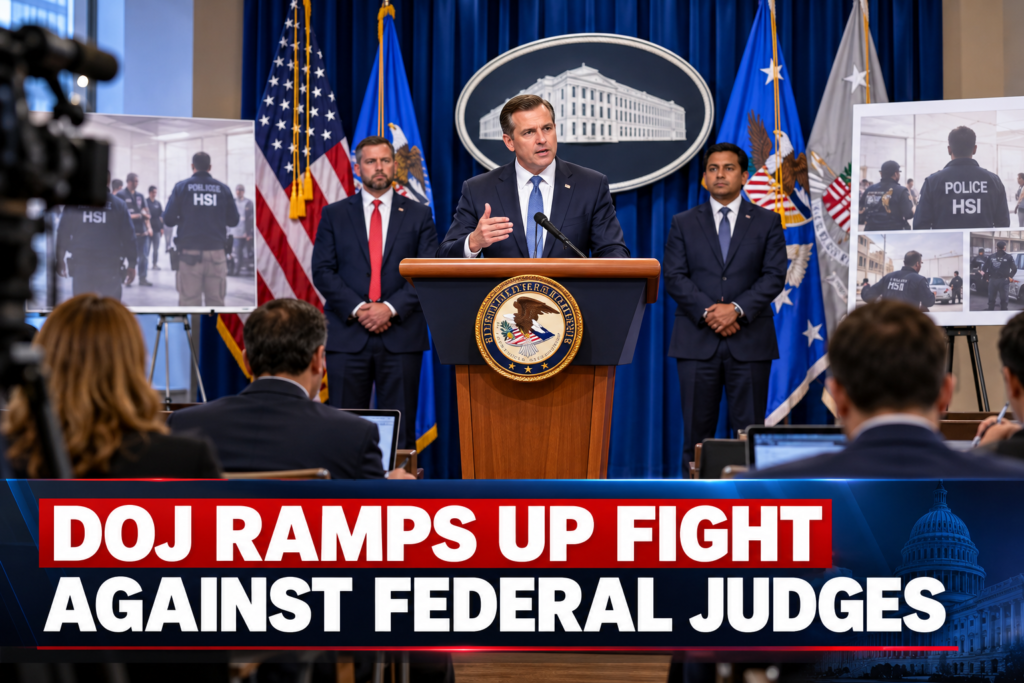
The Justice Department has filed a judicial misconduct complaint against nearly all of the federal judges in Minnesota, Attorney General Todd Blanche announced on Wednesday. The move deepens the conflict between the Trump administration and the judiciary over how courts handled immigration cases during a recent enforcement surge.
The Justice Department says six active Minnesota federal judges broke ethics rules by speaking to The New York Times. Blanche wants them off DHS-related cases while the complaint is pending. The bar for disqualifying a judge is high, and earlier Justice Department efforts against judges have not succeeded.
Key Facts at a Glance
What the Judicial Misconduct Complaint Alleges
Blanche said the judges’ remarks were political in nature and showed clear bias against the Department of Homeland Security. He also argued that the judges discussed cases that are still pending, which he says violates judicial rules.
The complaint names the six active judges who took part in the Times story. A seventh active judge on the court did not speak to the newspaper.
While the complaint is pending, Blanche is asking the district judges to step aside from DHS-related cases. Complaints about federal judges in Minnesota go to the Eighth Circuit Court of Appeals, according to the Minnesota Board on Judicial Standards.
At a news conference, Blanche said the judges spoke to the media about cases, some of them ongoing, in a way the department sees as a clear breach of their ethical duties.
Why the Judges Spoke to The New York Times
In the article, judges described the Justice Department’s failure to comply with court orders during an immigration-enforcement surge as a grave threat to the rule of law. Fox News reported that seven of the district’s judges spoke to the Times, including former Chief Judge Patrick Schiltz, who gave a 90-minute interview about the court’s experience.
The surge, known as Operation Metro Surge, brought thousands of immigration agents to the Twin Cities starting in December 2025, according to Law&Crime. Reuters reported that hundreds of lawsuits from people challenging their detention then flooded the court.
In their comments, the judges focused on how Justice Department staffing shortages appeared to limit the government’s ability to follow their orders. They have made similar remarks before in legal settings. In February, Reuters reported that the department removed a DHS lawyer from a Minnesota assignment after she told a judge that immigration authorities had failed to comply with court orders.
How the Justice Department has responded
After the Times report, a department spokesperson told Fox News Digital it was remarkable for sitting judges to give on-the-record interviews about administration policies instead of ruling from the bench. The spokesperson also said the heavy caseload of detention challenges would not exist if judges followed the law.
Rules for Judges Speaking to the Press
The dispute touches a broader debate in the legal world over whether judges may criticize an administration’s actions outside a courtroom. Some judges have spoken out, on and off the record, about concerns over democratic norms. Some have also criticized the Supreme Court for reversing lower court rulings with little explanation.
Sen. Chuck Grassley of Iowa and Rep. Jim Jordan of Ohio, the Republican chairs of the Senate and House Judiciary Committees, asked Chief Justice John Roberts to stop judges from talking to the press, particularly anonymously.
The Judicial Conference’s conduct committee gave more nuanced guidance. An ethics advisory issued in February said judges may, in some circumstances, offer a measured defense of colleagues against illegitimate attacks that threaten judicial independence. It also told judges to weigh the tone, context and form of what they say.
The judges quoted by the Times spoke on the record. Judge Nancy Brasel, a Trump appointee from his first term, told the paper that judges are allowed to speak about judicial independence and should do so to protect it.
Will the Recusal Demand Change Anything?
The demand may have little effect. Earlier efforts and public complaints against judges have gone nowhere, and the bar for disqualification is high. A similar judicial misconduct complaint strategy would still need the appeals court to act.
The administration has tried other tactics. It filed an unsuccessful lawsuit against the entire federal bench in Maryland, challenging an order that limited its ability to quickly remove migrants fighting deportation. Top officials have also criticized judges by name in sharp language.
Earlier this year, Fox News reported that Judge Jeffrey Bryan declined a Justice Department request to recuse himself from a Minnesota immigration case. The department had pointed to his wife’s role as the state’s solicitor general. Bryan called the motion improper, untimely and lacking merit, and the department said it planned to appeal.
Judges across the country have warned that heated public rhetoric raises the risk of threats and intimidation.
Frequently Asked Questions
1Who filed the judicial misconduct complaint?
The Justice Department filed it, and Attorney General Todd Blanche announced it on Wednesday.
2Which judges are targeted?
The complaint covers nearly all of Minnesota’s federal judges, specifically the six active judges who took part in the Times story.
3What prompted the complaint?
A New York Times article in which judges described the Justice Department’s failure to comply with court orders during an immigration surge as a grave threat to the rule of law.
4What does Blanche want while the complaint is pending?
He is calling on the district court judges to recuse themselves from DHS-related cases while the federal appeals court overseeing Minnesota considers the complaint.
5Is the recusal demand likely to work?
It may not have much impact. Earlier efforts against judges have gone nowhere, and the bar for disqualifying a judge is high.