
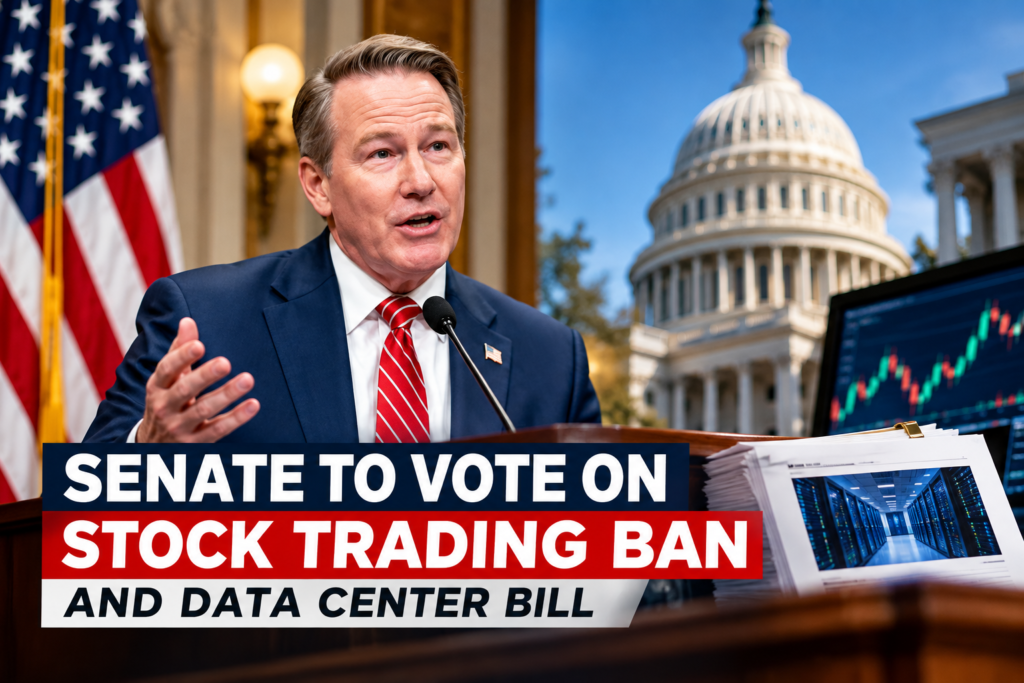
The Senate stock trading ban is facing a procedural vote on Wednesday, September 30, alongside a bill on data center energy costs. Reports say neither measure is expected to reach the 60 votes needed to advance, and Democrats have signaled opposition to both.
Story at a glance
Senate Republicans are forcing votes on two House-passed bills before a recess of more than a month. Democrats call the stock bill too weak and the data center bill toothless. Republicans may use the votes in their midterm campaigns.
What the Senate is voting on
Senate Majority Leader John Thune has scheduled a series of votes that could be the chamber’s last before a pre-election recess. The votes are procedural, meaning they test whether each bill can move forward.
Both bills already passed the House. One is the Stop Insider Trading Act, a congressional trading measure. The other is the Ratepayer Protection Act, which deals with the cost of powering data centers.
| Vote date | Wednesday, September 30, 2026 |
|---|---|
| Trading bill | Stop Insider Trading Act (H.R. 7008) |
| House vote on it | 232-198 on July 22 |
| Data center bill | Ratepayer Protection Act (H.R. 9340) |
| House vote on it | 417-3 |
| Votes needed | 60 to overcome a filibuster |
How the Senate stock trading ban would work
The Stop Insider Trading Act would bar members of Congress, their spouses and their children from buying individual stocks. It would also require seven days of public notice before a member sells a stock, according to Sen. Pete Ricketts, R-Neb., who has championed the bill.
The House passed the bill on July 22 by a vote of 232-198. Only 13 Democrats voted for it. Members would be allowed to keep stocks they already own, which is one reason many Democrats say it falls short.
The voter ID provision
The House bill also carries voter ID language taken from the SAVE America Act. Democrats have called that add-on a “poison pill,” and it is widely described as the main obstacle in the Senate. House Democratic leader Hakeem Jeffries also objected that the bill leaves out the president, vice president and cabinet.
Sen. Josh Hawley, R-Mo., has said he would work with the House version but wants tougher penalties and a broader ban. He sponsors a separate, stricter measure called the HONEST Act.
The data center energy bill
The Ratepayer Protection Act passed the House earlier this month, 417-3. It is aimed at keeping data centers from pushing up household electricity bills. Supporters present it as a response to affordability concerns.
Democrats point to a key weakness: the standard would be voluntary. Sen. Martin Heinrich, D-N.M., the top Democrat on the Energy and Natural Resources Committee, blocked an attempt by Sen. Jon Husted, R-Ohio, to pass the bill by unanimous consent on September 17. He argued it did not do enough to protect existing customers from rate increases.
Senate Democratic leader Chuck Schumer has called it a “toothless messaging bill.” Sen. Jacky Rosen, D-Nev., told The Hill she plans to vote against it.
Midterm politics behind the votes
Republicans could use the votes to score wins ahead of the November midterm elections. The Hill reported that the schedule was designed to help incumbents Husted, Ricketts and Dan Sullivan, R-Alaska. Democrats have largely rejected that framing while criticizing the bills themselves.
Schumer has also described the stock trading proposal as a “theatrical farce.” The Senate stock trading ban has long been a popular idea with voters, and lawmakers in both parties have faced pressure to act. Democrats argue the House version is not a true ban because it restricts new purchases rather than all trading. They have backed other proposals that would cover the president, vice president and cabinet with fewer exceptions.
Republicans, for their part, say Democrats are blocking a chance to curb insider trading. Ricketts, who faces a competitive race, has argued that lawmakers should be held to the same standards as ordinary citizens. Supporters of the Senate stock trading ban point out that the bill passed the House with some Democratic support.
Whatever the final tally, the votes put each senator on record before voters head to the polls. The Senate stock trading ban and the data center bill may return after the recess, but any deal would likely require changes that win over Democrats. A bipartisan compromise would need to address the voter ID dispute and the voluntary nature of the data center standard. Sen. Bernie Moreno, R-Ohio, said Democrats “want insider trading to continue.”
What happened in the Wednesday votes
The Senate began a three-part vote series at 11:30 a.m., according to The Hill. It covered the data center bill, the trading bill and the nomination of Labor Secretary Keith Sonderling to the permanent post. The same outlet later reported that Democrats blocked the trading bill.
The full outcome for the data center bill was not confirmed at the time of writing. For the original reporting on the plan, see CNBC’s coverage. Readers should check official Senate roll call records for final tallies.
Frequently asked questions
When is the Senate voting on the stock trading ban?
Senators scheduled procedural votes for Wednesday, September 30, 2026, which could be their last session before a recess of more than a month.
What would the Stop Insider Trading Act do?
It would bar members of Congress, spouses and children from buying individual stocks and require seven days of public notice before sales.
Why do Democrats oppose it?
They say it lets members keep current holdings, leaves out the president and cabinet, and includes voter ID language they call a poison pill.
What is the Ratepayer Protection Act?
It is a House-passed bill, approved 417-3, meant to address data center-related utility costs through a voluntary standard.
Will either bill become law?
Not soon. Neither was expected to reach 60 votes, and The Hill reported Democrats blocked the trading bill.