
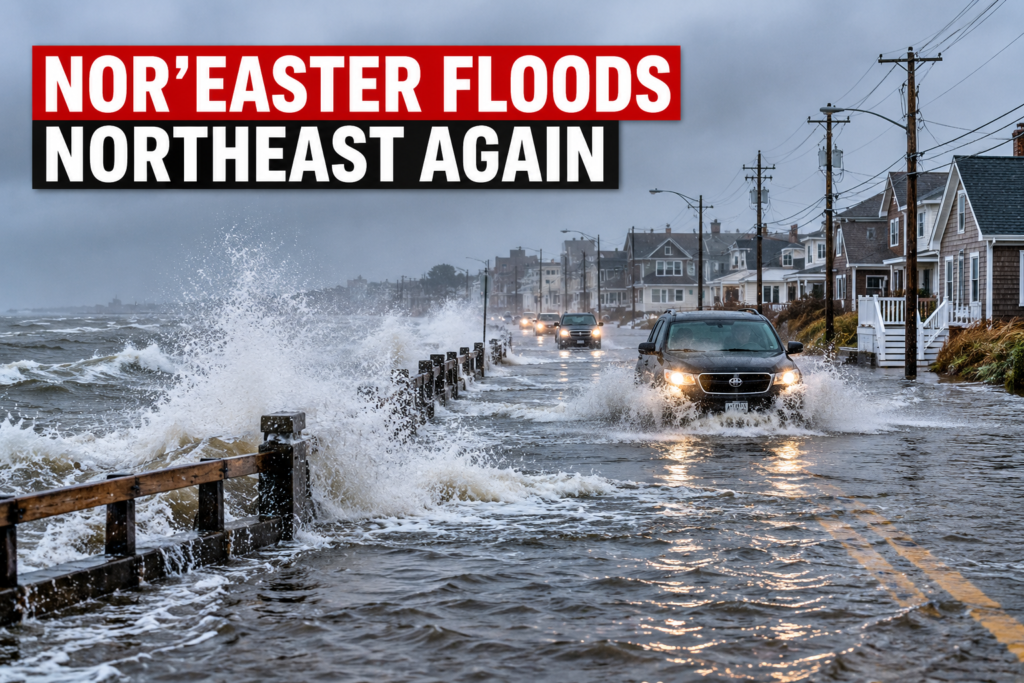
Coastal residents across the Northeast waded through water for a second straight day on Sunday as nor’easter flooding spread from New Jersey to New England. The slow-moving storm knocked out power to tens of thousands of homes, toppled trees and left at least one person dead.
A powerful, slow-moving nor’easter pushed ocean water into low-lying towns while strong winds downed trees and power lines. A city housing worker died in Brooklyn. Forecasters expect the storm to weaken Sunday night, but officials warn that high tide late Monday could bring more flooding.
Tidal Surges Swamp Low-Lying Neighborhoods
Tidal surges flooded low-lying neighborhoods in New Jersey on Sunday. On Long Island in New York, wind gusts brought down trees, damaged homes and pulled down utility poles.
In the New Jersey beach town of Sea Bright, every high tide brought a fresh round of water. Resident Caroline Virenius told The Associated Press her garage filled with about a foot of water and that it kept getting wet again and again. The pattern shows how a storm that lingers can be as disruptive as one that hits hard and leaves quickly.
Rain added to the problem. Some spots in New Jersey received more than 4 inches (10 centimeters) since Friday. Combined with a surging ocean, that produced flood levels residents said they had not seen in close to a decade, even in places used to high water.
Key Facts About the Storm
| Detail | What is reported |
|---|---|
| Areas hit | New Jersey, New York, Long Island and New England |
| Death reported | A New York City Housing Authority worker, killed by a falling tree Saturday |
| Rainfall | More than 4 inches since Friday in parts of New Jersey |
| Peak Long Island gust | 81 mph at Montauk Point, per the National Weather Service |
| Next concern | High tide late Monday may bring more flooding |
Deadly Winds and Widespread Power Outages
The storm’s first reported death came Saturday in Brooklyn, where a tree fell on a New York City Housing Authority employee. The city’s fire department also said four people suffered minor injuries when a tree struck them in the Kelly Park section of the borough.
Power problems grew through the weekend. According to The Weather Channel’s report, more than 130,000 customers were without power Sunday morning, based on PowerOutage.us data. The worst outages were in New York state, including Long Island. New Jersey reported about 50,000 customers out, and Connecticut about 25,000.
On Long Island, PSEG Long Island said it had restored power to 93,700 of its 1.2 million customers by Sunday evening. About 18,500 remained without service, according to Long Island Press. The National Weather Service recorded the 81 mph gust at Montauk Point and up to 3.3 inches of rain in East Hampton.
How Officials Responded to the Nor’easter Flooding
State and local leaders acted before the worst arrived. New Jersey Gov. Mikie Sherrill declared a state of emergency for eight counties, according to ABC News. A voluntary evacuation was issued in Point Pleasant, where families carried belongings through flooded streets on Saturday.
New York Gov. Kathy Hochul urged people to stay out of the water, warning that entering the sea or its edge during the storm was a gamble with their lives. Even so, some people kayaked down flooded streets or went to beaches to surf the higher waves.
Emergency crews in Sea Bright rescued a woman and her dog after their vehicle became trapped in floodwater, ABC7 reported. The Federal Emergency Management Agency said its response coordination centers in affected regions were operating at an enhanced level of readiness.
What to Expect Next
The National Weather Service expects the storm to weaken Sunday night, though local heavy rain could continue in parts of New England and the mid-Atlantic. Local officials in New Jersey and New York cautioned that high tide late Monday could still cause flooding.
Nassau County Executive Bruce Blakeman said another, weaker band of the storm could arrive Sunday afternoon and continue into the evening. A coastal flood advisory for parts of Long Island runs through 2 p.m. Monday, and forecasters advise drivers to avoid barricaded roads and water of unknown depth.
The storm also brought back memories of Superstorm Sandy, which caused more than $60 billion in damage across the eastern United States in 2012. This storm’s impact has been far smaller. Still, it could be the first of several along the East Coast this fall because an El Niño climate pattern is disrupting this year’s weather.
Nor’easter Flooding: Your Questions Answered
1Where did the storm cause the most flooding?
Coastal and low-lying areas of New Jersey saw repeated flooding from tidal surges, and streets in New York City neighborhoods such as Howard Beach in Queens were also inundated.
2Has anyone died because of the storm?
Yes. A New York City Housing Authority worker was killed Saturday when a tree fell in Brooklyn, according to the agency and The Associated Press.
3How many customers lost power?
Counts changed through the weekend. More than 130,000 customers were without power Sunday morning, with the most in New York state, according to The Weather Channel.
4Is more flooding possible?
Yes. The storm should weaken Sunday night, but officials in New Jersey and New York said high tide late Monday could bring more flooding.
5How does this compare with Superstorm Sandy?
Sandy caused over $60 billion in damage in 2012. This storm’s impact has been nowhere near that, though more storms could follow this fall because of El Niño.