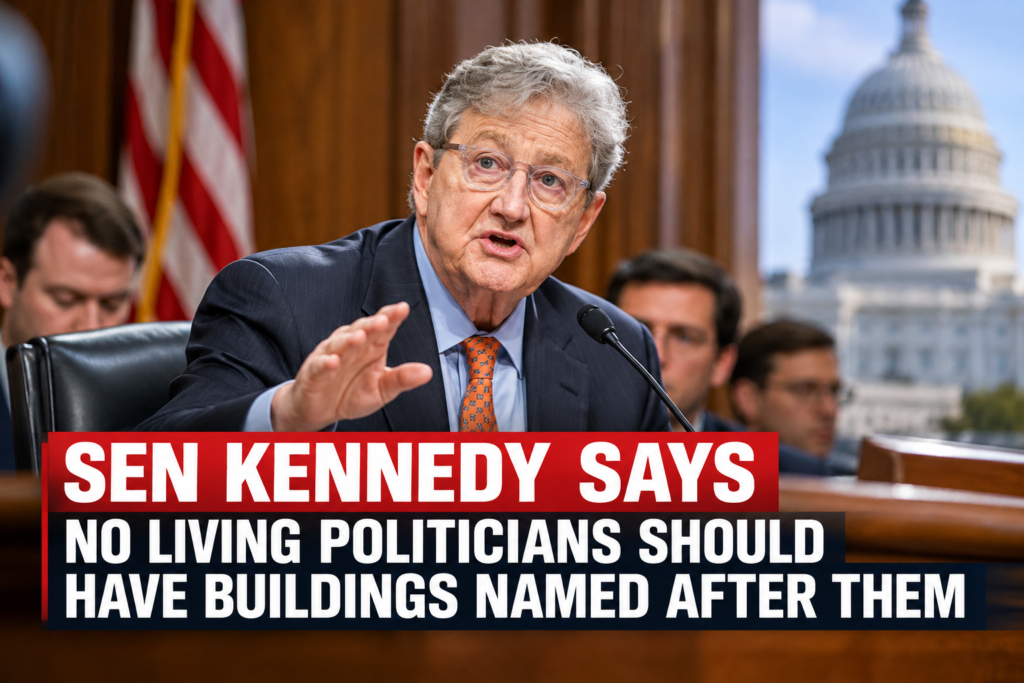
PoliticsSen. John Kennedy, R-La., says buildings named after living politicians should be off the table. He made the case Sunday on CBS News’ “Face the Nation,” as President Donald Trump keeps pushing to put his name on the Kennedy Center and other federal sites in Washington, D.C.
The Short Version
Kennedy floated a rule that no politician should have a building named after them while alive. He also said officials should not use public money for ads promoting themselves. Separately, a federal judge ruled in May that only Congress can rename the Kennedy Center.
What Sen. Kennedy Said on Face the Nation
Kennedy spoke with host Margaret Brennan. He said public officials, including Trump, should not “spend public money on private ads for themselves.” He acknowledged the White House sees the issue differently, but argued that officials cannot use public funds to promote themselves.
He then widened the point. Kennedy suggested a rule ending buildings named after living politicians, meaning no politician could have a building named for them while still alive. Benzinga reported he believes such a rule would “settle a lot of this controversy.” He also said Louisiana already has a rule against using public money for self-promotion and that it works well.
Kennedy added a light-hearted note. He said he might end up mocked for the idea, a nod to Trump sharing AI videos last year that showed Senate Minority Leader Chuck Schumer and House Minority Leader Hakeem Jeffries in sombreros.
Why Buildings Named After Living Politicians Are Back in the Spotlight
Since returning to the White House last year, Trump has sought to rename several prominent federal buildings in Washington after himself, according to Fox News reporting on Kennedy’s remarks. Kennedy’s comments land in the middle of that effort, which has already drawn court challenges.
The senator is a Republican, like the president. His proposal on buildings named after living politicians is therefore notable as a call for a naming limit that would cover officials from both parties, himself included. He said the same standard applies to Trump, former Homeland Security Secretary Kristi Noem and himself.
The Taxpayer-Funded Ad Behind the Debate
Kennedy spoke as a new ad promoting Trump appeared on multiple networks. The federal government paid for it. Brennan told Kennedy the 30-second spot would air during the program and ends with a line saying the U.S. government paid for it.
Benzinga, citing CNN, reported the ad aired during two NFL games on Sunday. A White House spokesperson defended it as a public service announcement about national pride, describing it as educational and patriotic.
Brennan also reminded Kennedy of his sharp questioning of Noem, when she was secretary, over Department of Homeland Security ads that used taxpayer money.
The Kennedy Center Naming Fight
The December vote
Trump’s handpicked board voted in December 2025 to rename the venue the Trump-Kennedy Center. Trump chairs that board, ABC News reported. His name went up on the facade within days. The move drew protests from Democrats and some members of the Kennedy family, and Rep. Joyce Beatty, D-Ohio, sued.
The court ruling
On May 29, 2026, U.S. District Judge Christopher Cooper ruled that the board overstepped its authority. In a 94-page decision, he said Congress named the center and only Congress can change that name. He ordered the removal of signage and online references within 14 days and temporarily blocked a planned two-year closure for renovations, NPR reported.
Trump responded that he had no interest in continuing the overhaul and wanted decisions returned to Congress, ABC News reported. Fox News later reported that the board’s emergency appeal to stop the removal was denied.
Other Sites Tied to Trump’s Name
The Kennedy Center is not the only example. The State Department added Trump’s name to the U.S. Institute of Peace last year. Former institute officials, who were removed by the administration, filed a court motion earlier this month to stop crews from placing the name on the building’s exterior.
Trump also suggested earlier this year that New York’s Penn Station and Dulles Airport near Washington be named after him as a condition of a funding deal. He has floated a promenade linking the back of the Lincoln Memorial to the Potomac River as well. He said allies wanted to call it the “Trump Promenade,” but added that he was unsure he wanted that.
What Comes Next
Reports describe Kennedy’s idea as a proposed rule. None lay out legislative text, a sponsor list or a vote schedule. Whether other lawmakers take up a ban on buildings named after living politicians remains unclear.
The Kennedy Center question, meanwhile, now rests with Congress under Cooper’s ruling. The Institute of Peace dispute is still before a court.
Frequently Asked Questions
1. What did Sen. John Kennedy propose?
He proposed a rule that no politician should have a building named after them while alive. He spoke on CBS News’ “Face the Nation” on Sunday.
2. Why did he raise the issue now?
Trump has been pushing to rename the Kennedy Center and other federal buildings after himself. A federally funded ad promoting Trump was also airing on multiple networks.
3. Who can rename the Kennedy Center?
Judge Christopher Cooper ruled that only Congress can change the name, because Congress named the center in law.
4. How did the White House defend the ad?
A spokesperson called it a public service announcement about national pride, describing it as educational and patriotic, according to Benzinga.
5. Is there a bill to ban these namings?
The reports reviewed describe a proposed rule but do not mention bill text, sponsors or a timeline.