Attorney General Todd Blanche spent Sunday defending the Trump administration’s tightened grip on White House press access, telling ABC’s “This Week” that reporters have no guaranteed right to cover the president in person. His comments came a day after CNN was barred from flying with President Donald Trump aboard Air Force One to Tennessee, and days after a federal judge ordered the administration to temporarily restore credentials it had revoked from three news organizations.
CNN Blocked From Air Force One Trip
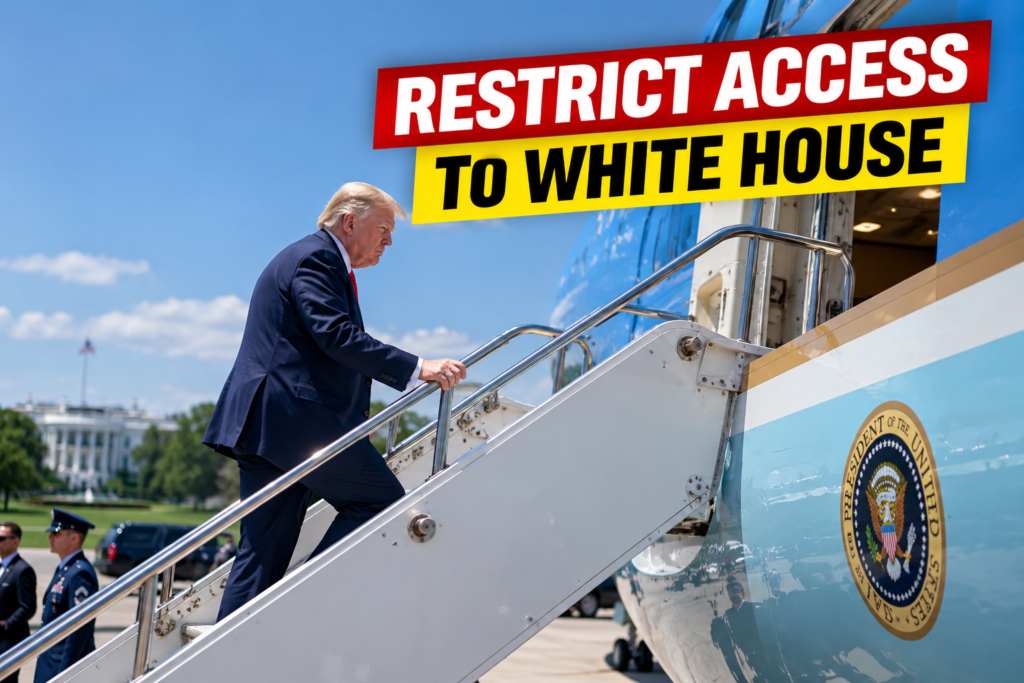
CNN had been scheduled to serve as the television pool outlet covering Trump’s Saturday trip to a college football game in Tennessee. The network said it was denied a seat on Air Force One for that trip. Trump signaled his stance that morning on Truth Social, writing that “fake news” outlets should not have a place inside the White House.
Blanche told host Martha Raddatz the president is free to choose who accompanies him. He argued the decision was not unusual, saying the White House routinely decides which reporters travel on presidential trips and that seats are not automatically guaranteed to any single network.
📌 Quick Summary
Attorney General Todd Blanche defended the White House’s decision to exclude CNN from Air Force One and to restrict three outlets from the grounds, calling access “a privilege, not a right.” The comments followed a court order requiring the administration to temporarily restore press credentials while litigation continues.
Judge Orders Credentials Restored
The dispute traces back to a White House decision to bar CNN, MS NOW and POLITICO from the grounds entirely, a move the administration tied to what it called inaccurate coverage. U.S. District Judge Timothy Kelly, a Trump appointee, issued a temporary restraining order requiring the credentials to be reinstated for at least two weeks while the underlying lawsuit continues.
Kelly’s order expressed doubt about the government’s central justification. He wrote that the court was skeptical the administration’s stated national security concerns reflected its actual motivation for the ban, according to reporting reviewed alongside the court filing. Journalists returned to the grounds later that week, and pool television coverage resumed in time for the final day of Chinese President Xi Jinping’s state visit, before CNN was singled out again for the Tennessee trip.
Blanche Frames Coverage as a National Security Issue
During the ABC interview, Blanche leaned on a national security rationale, arguing that inaccurate reporting from the affected outlets could damage U.S. relationships with foreign partners and adversaries alike. He said the administration wants coverage that foreign governments and citizens abroad can trust as accurate.
Pressed by Raddatz to cite specific examples of reporting the White House considers false, Blanche declined to provide any. He also argued that the president’s frustration followed years of what he described as one-sided coverage, and that Trump ultimately decided to act on it.
The Justice Department has made similar national-security arguments in other legal fights this year, including cases involving construction projects on the White House grounds, according to court filings referenced in coverage of the litigation.
Key Facts: The White House Press Access Fight
| Detail | Information |
|---|---|
| Outlets affected | CNN, MS NOW, POLITICO |
| Judge overseeing case | U.S. District Judge Timothy Kelly |
| Court action | Temporary restraining order restoring credentials for at least two weeks |
| Latest incident | CNN blocked from Air Force One for Sept. 26 Tennessee trip |
| Administration’s stated rationale | National security concerns tied to accuracy of coverage |
| Outlets’ legal argument | Restrictions violate First Amendment and due process rights |
How Other Networks Responded
CNN’s removal from the pool rotation also drew a reaction from its broadcast peers. ABC, CBS, NBC and Fox News, which along with CNN normally rotate responsibility for daily White House pool coverage, declined to fill CNN’s spot for the Tennessee trip, leaving no television pool coverage of the event that day.
In the weeks surrounding the dispute, the White House also launched its own streaming channel, an outlet the administration controls directly rather than relying on independent pool coverage.
What Happens Next
The underlying lawsuit filed by CNN, MS NOW and POLITICO remains active, and Kelly’s temporary order is not a final ruling. Blanche said Sunday that the litigation would continue and that he would not comment further on the judge’s specific findings. For now, the administration is continuing to assert that it has broad discretion over who receives White House press access, even as the case moves forward in federal court.
Additional background on the credentialing dispute and the judge’s written order is available through public federal court records.
Frequently Asked Questions
Why was CNN blocked from Air Force One?
The White House excluded CNN from its scheduled turn in the television pool rotation for President Trump’s Sept. 26 trip to Tennessee. Officials did not cite a specific story as the reason.
What did Attorney General Blanche say about press access?
Blanche said being in the White House or traveling with the president is a privilege rather than a guaranteed right, and that the president can decide which reporters accompany him.
What did the federal judge rule?
Judge Timothy Kelly issued a temporary restraining order requiring the administration to restore White House press credentials to CNN, MS NOW and POLITICO for at least two weeks while the lawsuit continues.
What is the administration’s justification for the restrictions?
Officials have pointed to national security, arguing that reporting they consider inaccurate could harm U.S. relationships with foreign governments and partners.
How did other TV networks respond to CNN’s exclusion?
ABC, CBS, NBC and Fox News, which share pool duties with CNN, chose not to take CNN’s place for the Tennessee trip, leaving that day without television pool coverage.