
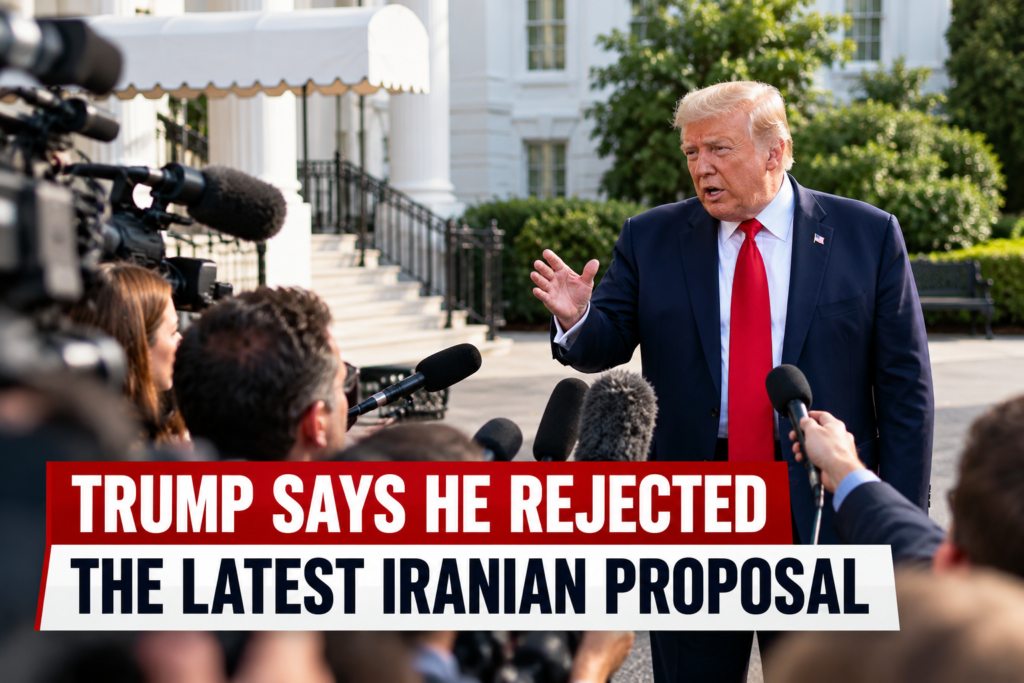
President Trump said Saturday that he has rejected Iran’s latest Strait of Hormuz proposal, a plan Tehran says could reopen the critical waterway and restart nuclear talks within seven days. The rejection came after indirect talks in New York this week failed to close a wide gap between Washington and Tehran over sanctions, a naval blockade, and a regional ceasefire.
⚡ At a Glance
Iran offered a seven-day plan to reopen the Strait of Hormuz and resume nuclear negotiations if the U.S. lifted its naval blockade, waived oil sanctions, and observed a wider regional ceasefire. Trump called the offer “not acceptable,” while Tehran says it is still awaiting a “definitive” response through Qatari mediators.
What Iran Put on the Table
Iranian Foreign Minister Abbas Araghchi met U.S. envoys Steve Witkoff and Jared Kushner on the sidelines of the United Nations General Assembly this week, with Qatari officials relaying messages between the two delegations. According to Araghchi, Iran’s Strait of Hormuz proposal would restore normal maritime passage within seven days if the U.S. lifted its naval blockade, waived sanctions on Iranian oil sales, and reinstated a ceasefire covering the wider region, including Lebanon.
“If the necessary conditions are met, the strait can be reopened and normal maritime passage restored within seven days,” Araghchi told reporters, adding that the choice now rested with Washington. Iran has framed the plan as consistent with a memorandum of understanding the two countries signed in June, which briefly paused fighting before collapsing after renewed strikes.
Trump’s Response
Speaking to reporters outside the White House before departing for a college football game, Trump confirmed he had turned down the offer. “They have made a proposal and I rejected it,” he said, arguing that Iran only wants a quick deal because it is “losing so badly.” He said the U.S. maintains “total control” of the strait, citing dozens of tankers moving through daily under American protection.
A U.S. official told reporters that despite the public rejection, “positive and constructive” discussions were continuing through mediators, including on nuclear issues. Separately, reports indicate Trump is weighing renewed military action against Iran after the November midterm elections if talks continue to stall.
Key Facts
| Detail | Summary |
|---|---|
| Proposal | Reopen Strait of Hormuz & resume nuclear talks within 7 days |
| Iran’s Conditions | End U.S. naval blockade, waive oil sanctions, regional ceasefire |
| U.S. Response | Trump publicly rejected the offer as “not acceptable” |
| Negotiators | Steve Witkoff, Jared Kushner (U.S.); Abbas Araghchi (Iran); Qatar (mediator) |
| Where | Sidelines of the UN General Assembly, New York |
| Background | Iran closed the strait after U.S.–Israeli strikes began Feb. 28, 2026 |
Iran’s Reaction
Tehran has not treated Trump’s public comments as a final answer. Araghchi said Iran is still waiting for a “definitive” response through mediators, noting that Trump has said “many contradictory things” in the past. Iranian President Masoud Pezeshkian, who also attended the UN gathering, told the assembly that Tehran no longer fully trusts negotiations with Washington, pointing to past talks that were followed by new strikes and sanctions. Pezeshkian left New York for Tehran after the summit concluded.
Why the Strait Matters
The Strait of Hormuz is one of the world’s busiest oil chokepoints, and disruptions there have rattled energy markets since fighting began. U.S. officials say dozens of tankers are still moving through the strait each day under American protection, with roughly 60 million barrels reported to have transited over a recent 72-hour period — well below pre-war volumes but enough to ease some pressure on global supply.
Any lasting resolution will likely hinge on issues well beyond shipping routes, including sanctions relief, prisoner and asset questions, and the future of Iran’s nuclear program. For now, both sides remain publicly far apart even as backchannel talks continue. According to PBS NewsHour’s reporting, mediators are continuing to shuttle messages between Washington and Tehran despite the public standoff.
Frequently Asked Questions
What did Iran offer in its Strait of Hormuz proposal?
Iran proposed reopening the strait and resuming nuclear talks within seven days if the U.S. lifted its naval blockade, waived oil sanctions, and reinstated a regional ceasefire.
Why did Trump reject the proposal?
Trump said the offer was “not acceptable,” arguing Iran only wants a quick deal because it is losing ground and that the U.S. already controls shipping through the strait.
Who is negotiating on each side?
U.S. envoys Steve Witkoff and Jared Kushner have met Iranian Foreign Minister Abbas Araghchi, with Qatar acting as mediator between the two delegations.
Is the Strait of Hormuz currently closed?
Iran effectively closed the strait after U.S. and Israeli strikes began on Feb. 28, 2026, though tankers have continued moving through it under U.S. protection at reduced volumes.
Could talks between the U.S. and Iran continue?
Yes. A U.S. official said discussions through mediators remain “positive and constructive,” even as Trump publicly rejected Iran’s latest offer.